Laika put out a new trailer for Wildwood today, and I nearly filed it under “nice puppets, next.” Then I went looking for the production numbers behind it and stopped scrolling. This is the studio’s first stop-motion feature since 2019’s Missing Link, directed by co-founder Travis Knight and adapted from Colin Meloy and Carson Ellis’s illustrated novel, and it’s out October 23 through Fathom Entertainment. The premise, a girl named Prue chasing a murder of crows into a hidden forest outside Portland to get her baby brother back, is not why I’m writing this. The build is.
The scale is the headline
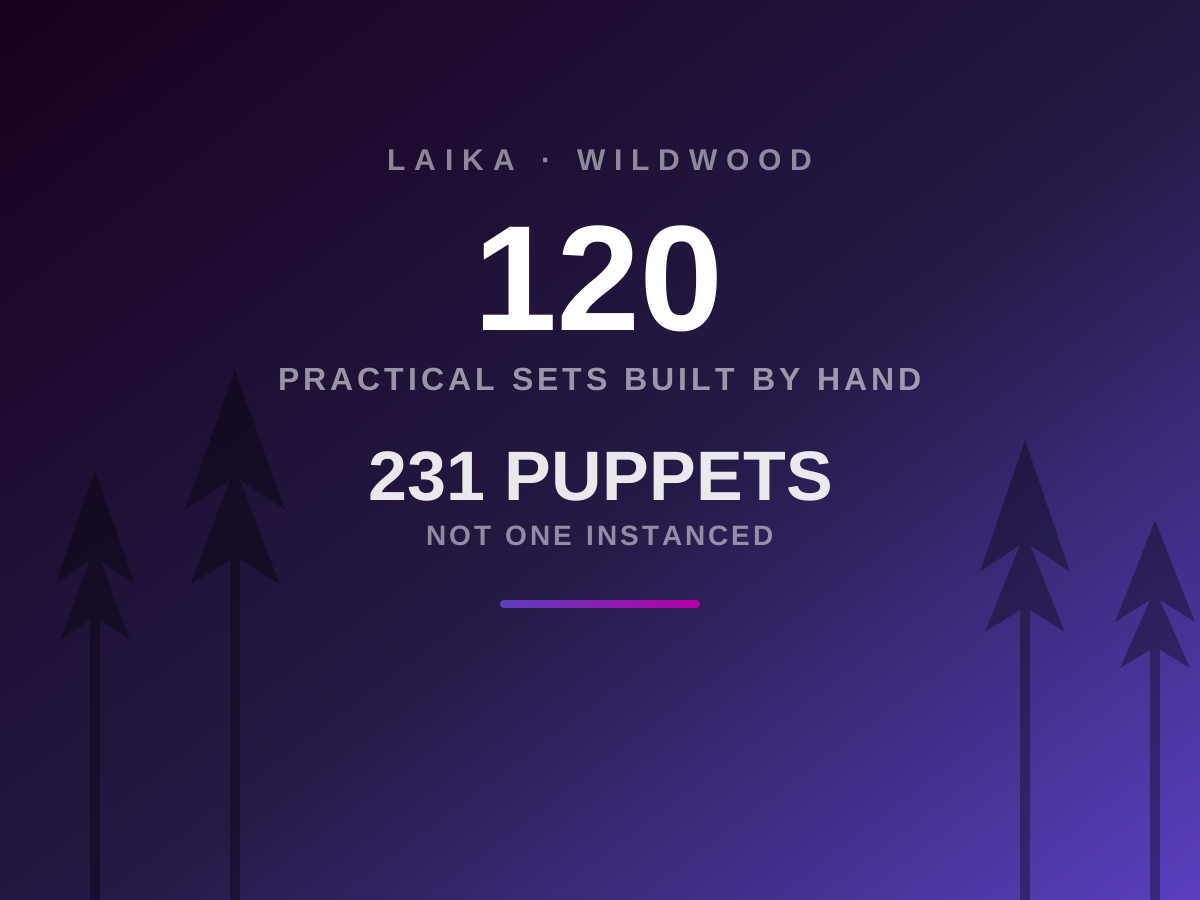
Reporting around the trailer and Laika’s own exhibition materials puts the film at 120 built sets, double the count on Kubo and the Two Strings, with some locations large enough that the crew can physically walk through them. On top of that there are 231 practical puppets and 54 hero characters, each engineered and costumed individually rather than reused. One set alone, a miniature built around the real Pittock Mansion in Portland, reportedly took more than eleven weeks and 45 to 50 artists from design through final dressing, with the surrounding forest made of individually crafted trees rather than a single repeated hero asset.
That’s the number that stopped me. In real-time or CG environment work, a forest is exactly the kind of thing you don’t hand-build tree by tree. You make one great tree, a couple of variants, scatter them procedurally with some rotation and scale noise, and spend your hand-crafting budget on the two or three hero trees the camera actually lingers on. Laika’s version of that same decision, on this film, was apparently to hand-build the whole forest anyway. That is a completely different economics of production art: when your unit of geometry is a physical object, your reuse tools are limited, so the entire studio budget is effectively “who has time to make one more tree.”
What a bespoke pipeline buys you, and what it costs
I’ve built enough digital environments to recognize the specific trade a team makes when it decides everything is bespoke:
- Nothing reads as a kit. Procedural scattering and asset reuse are efficient, but they leave a signature, a repeated silhouette, a texel density seam, a tell that a human didn’t personally decide where that specific rock goes. A set where every tree was individually made has no seams to find, because there’s no template to repeat.
- The cost is linear, not amortized. In CG, a modular kit pays for itself the moment you reuse a piece twice. A hand-carved miniature tree pays for itself never; each one costs roughly what the last one cost. Doubling your set count from Kubo to Wildwood doesn’t halve your per-set budget the way doubling your tile library would, it roughly doubles your total headcount-hours. That’s presumably a large part of why this is described as Laika’s most ambitious build to date.
- Walkable practical sets are the physical version of “no visible streaming seam.” A real-time environment artist worries about LOD pops and texture streaming breaking the illusion of a continuous space. A stop-motion crew building a set large enough to walk through is solving the analog version of the same problem: making a constructed space read as continuous from every angle the camera might actually use, with none of the tricks (fog, occlusion, a well-placed loading corridor) that digital space affords for free.
The part that would actually break my brain: crowds
The trailer reportedly includes large battle sequences with hundreds of characters in frame at once. In CG or a game engine that’s a crowd system: you author a handful of base rigs and animation cycles, then let a simulation vary timing, path and blend weights across an instanced crowd, and the computer does the repetitive part. Stop-motion has no equivalent shortcut. Every one of those puppets, in every one of those frames, has to be physically repositioned by hand before the next exposure. A crowd shot that a real-time engine renders as a single draw call with instancing is, on this film, a room full of animators each nudging one puppet a fraction of a millimeter, frame after frame, for however many days that shot takes.
I bring that up not to dunk on digital crowd tools, but because it’s a genuinely clarifying comparison: it shows exactly how much invisible infrastructure real-time environment and character pipelines have quietly built to make “a lot of things on screen at once” a solved problem. Laika is choosing, on purpose, not to have that infrastructure, because the whole appeal of the studio is that a human touched every single thing you’re looking at.
Why I’m actually going to see this one
I’m not a stop-motion artist and I’m not about to pretend the crafts are interchangeable. But the underlying problem, how much of a space to hand-build versus systematize, where reuse is a strength and where it’s a tell, is the same argument I have with myself on every level I block out. Laika just ran that argument at a scale and a level of commitment that most digital pipelines would consider financially insane, and from everything in the trailer coverage, it looks like it paid off on screen. That’s worth the price of a ticket on its own.
Production numbers (120 sets, 231 puppets, 54 hero characters, the Pittock Mansion build timeline) are as reported around Laika’s “Wildwood: The Exhibition” materials and covered by outlets including Variety, Deadline and Colossal; I wasn’t able to reach Laika’s own site directly through my usual channels, so I’m relying on that secondary coverage rather than the studio’s original materials. I couldn’t independently verify a usable trailer clip or an official image through the sources available to me this run, so this piece runs with the illustrated cover only rather than risk crediting the wrong source. The craft comparison to real-time and CG environment pipelines is my own reading, not Laika’s framing.