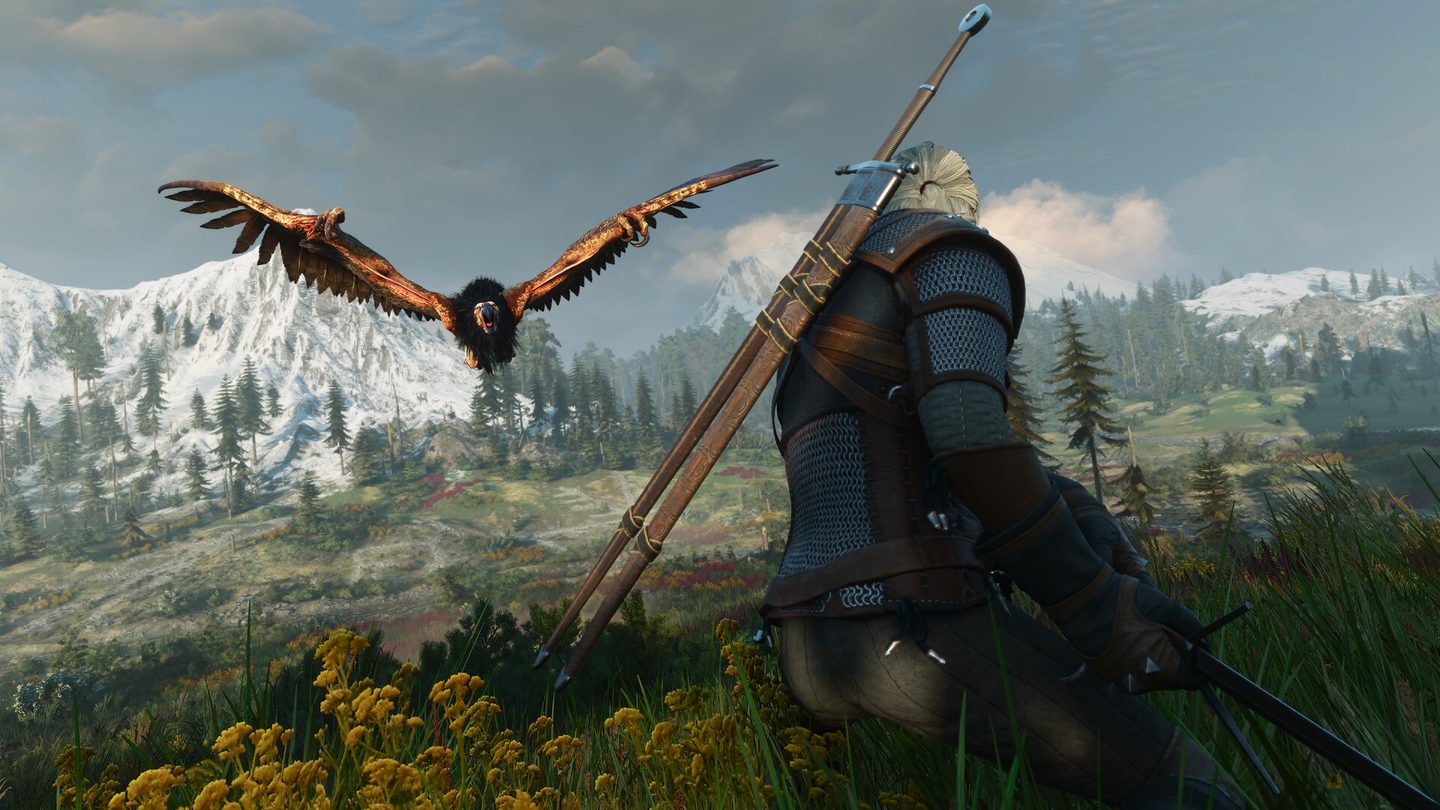
Jacek Rozenek has been the Polish Geralt since 2007. He had a stroke in 2019, and the voice that came back from it is not the voice sitting on the Witcher 3 master.
CD Projekt Red has now described what it did about that for Songs of the Past, the expansion arriving in 2027 on the old engine. Rozenek recorded the new lines himself. All of them. A generative model then shifted those recordings back toward his own performance in the base game, work reported as going through Respeecher, the Ukrainian firm CD Projekt has used before.
The order of operations is the whole thing
An actor performed, then a model converted. Nothing was generated from a script, and no second performer was hired to stand in.
Anyone who has retargeted a skeleton knows this shape. The curves come off a human being; what they drive is a different surface. You are not inventing motion, you are moving an existing performance onto a new target and arguing about how much the target distorts it. Here the performance is a man in a booth in 2026 and the target is the same man in 2015.
Compare the case CD Projekt ran in October 2023. Miłogost Reczek, the Polish Viktor Vektor in Cyberpunk 2077, died in 2021, and for Phantom Liberty the studio hired a different actor to speak the new lines and converted that performance into Reczek’s voice, with his family’s agreement. Technically adjacent. A different question entirely at the level of who made the acting choices — in 2023 those belonged to a living stand-in wearing a dead man’s timbre, and this time both the choices and the timbre are Rozenek’s, eleven years apart.
A continuity problem that predates the tool
Every series that runs a decade hits this. Voices age, actors move on, actors die, and the dialogue recorded in year eleven sits next to dialogue recorded in year one whether it matches or not. The industry’s existing answers are recasting and hoping nobody notices, or writing around the character.
Rozenek’s stated aim, per the reporting, was for the new voice to come as close as possible to his voice from twelve years ago. That is a continuity target. It is not a performance note, and the distinction matters when you are judging the result: the question is not whether he acts well, it is whether the conversion leaves his acting intact on the way through.
What a voice model learns besides a voice
My reservation sits in the training data, and it is a reservation rather than a finding.
A model built from the Witcher 3 sessions learned two things at once. It learned Rozenek, and it learned the booth he stood in, the microphone in front of him, and the processing chain a 2014 Polish localisation pass ran him through. Conversion toward that reference can drag the room along with the age. If the new recordings are cleaner — different room, twelve years of better converters, a different engineer — some of what the model pulls them toward is 2014’s signal path rather than 2014’s larynx.
Whether that shows depends on how much of the conversion is timbre transfer and how much is a broader spectral match, and nobody outside the project can tell that from a press line. It is the thing I would want to hear before calling the job clean.
Doug Cockle, meanwhile, records English normally. One language gets a model and the rest do not, which leaves the two most-played dubs matched to different reference points. For a player that is invisible. For anyone auditing dialogue consistency across localisations it is a new row in the spreadsheet.
The clause travels further than the technique
CD Projekt says its contracts require a performer’s consent for AI work, and its localisation team framed this as a special case tied to Rozenek’s health rather than a general method.
For working performers the transferable part of this story is that sentence about contracts. Voice conversion is cheap now and getting cheaper, and the argument over it has mostly been conducted in public statements rather than in paperwork. A consent clause is the mechanism — it is what makes the difference between this and the cases that have gone badly, and it is checkable in a way that a studio’s good intentions are not. The same split runs through where AI earns a place in a 3D pipeline: the techniques that survive contact with a working studio are the ones with a human decision upstream of them and a named person accountable for the output.
Two things I could not confirm. The exact wording attributed to CD Projekt about using AI ethically appears in headlines without a clearly named speaker, so I have paraphrased rather than quote it. And Respeecher’s involvement in this specific job comes from the trade reporting rather than from a statement by either company, which is worth knowing if you intend to cite it.