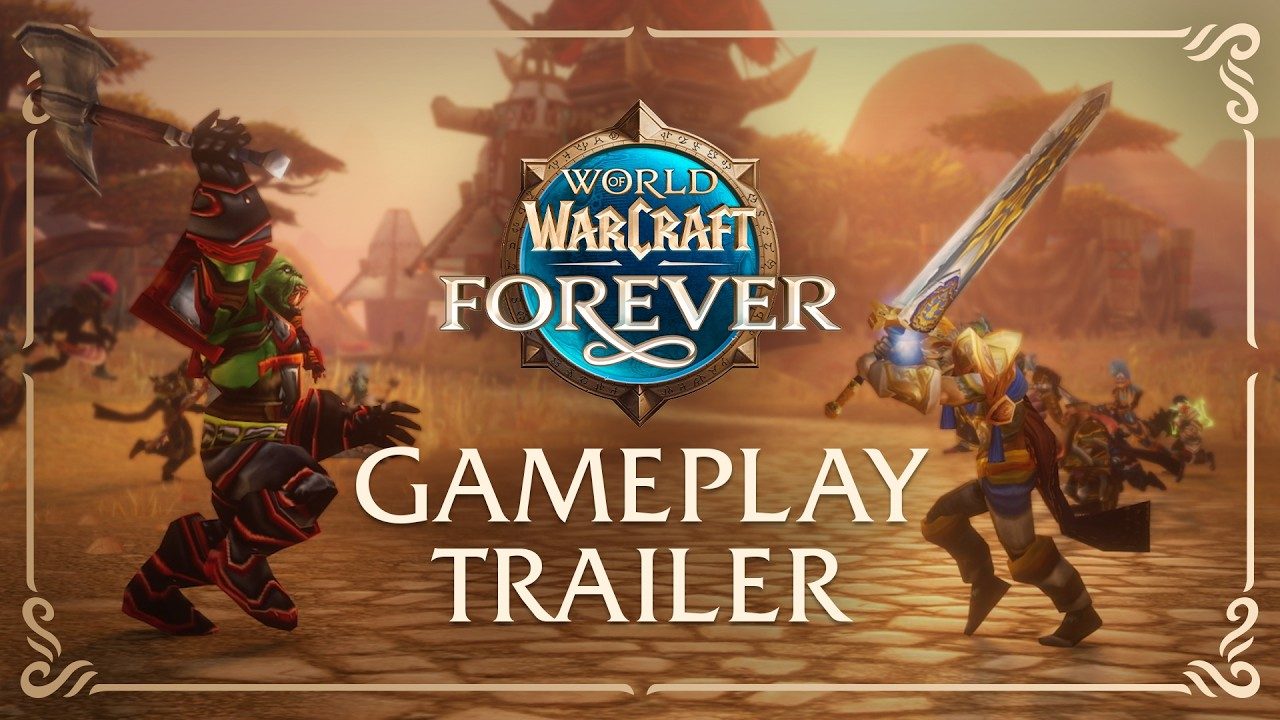
A skeleton is not a skin. That sentence is the whole argument about World of Warcraft: Forever’s character models, and it is worth unpacking before the launch on 4 November, because the thing players are asking Blizzard for and the thing Blizzard has shipped are different objects with very different costs.
Start with what happened. Forever is Blizzard’s answer to the Classic+ question, revealed at BlizzCon 2026, with a beta that ran from 17 September to 21 October. Early builds showed the modern high-definition character models, and testers pushed back hard — 80 Level’s account has beta regulars, Savix among them, making the case that an original-model option was not a nice extra. Blizzard moved. The character-creation portraits went back to the originals, and a toggle between SD and HD models went in.
Then the complaints changed shape. They stopped being “where are the old models” and became “these are not quite the old models”, which is the more interesting problem.
What a toggle actually asks for
Picture the feature request as a technical artist would receive it. Every character in the game can be drawn with either of two body meshes, switchable, per player, at any moment. Now price it.
If the two meshes share a skeleton, the bill is small. One animation library covers both. Weapons hang off the same hand bones. Shoulder pads, helmets and cloaks keep their single set of attachment points. Your skinning work is one re-weight pass per mesh and you are done.
If the two meshes carry their own skeletons, almost nothing is shared. Two animation sets, authored and maintained in parallel, including every emote anybody has ever added in twenty years. Two sets of attachment transforms. And the part that kills it: gear. WoW armour is modelled geometry conformed to a specific body — shoulders, helms, belts and boots are built against a torso and then fitted to it, so a second body means a second fit for every one of them. Thousands of items, each needing an art pass that produces no new content a player can see.
Nobody ships that for a toggle. So the toggle you get is the first version, and beta testers describe exactly that: older meshes and textures riding the retail skeleton. Worth saying plainly that this part is player reporting from forum threads rather than anything Blizzard has published, and the accounts disagree among themselves — one says the idle animations are straight from retail, another that the run and the auto-attack are the only classic-derived animations left. Blizzard has not laid out the construction, and until it does, the mechanism is inference from what people are seeing on screen.
But the inference fits the complaints unusually well. Look at the Night Elf thread: broad chest, thin shoulders. That is a rigging complaint in a texture complaint’s clothes. Bind a mesh authored against one bone hierarchy to another whose clavicles sit further out and whose spine segments run longer, and the shape has to change. The vertices follow the bones. The silhouette moves a few centimetres, in world units nobody wrote down, and twenty years of muscle memory notices immediately.
Remembering is not restoring
The most honest thing to come out of the beta is a stated aim, relayed through those same threads: the goal was not to replicate Classic but to build a version of what people remember Classic looking like. Which is why the animations, the lighting, the fog and the water are all altered rather than reproduced.
That is a defensible brief. It is also the opposite of the one a restoration takes, and the gap between the two is where the arguments live. When HIDIVE put a 4K scan of Ninja Scroll’s original negative into cinemas, what the audience got was the dust, the paint texture and the cel edges — the film as it was photographed, not as it is remembered. Memory smooths. Scans do not. Blizzard has picked memory, deliberately, and will therefore keep hearing from the people whose memory differs.
The Skyborne situation is the clearest tell about where this sits in the pipeline. The new race, sold with the Skyborne Heroic Pack and above, arrives with no SD model at all, and the SD version is reported for early 2027. A race designed after the toggle existed still did not get both bodies at launch. That is the cost of the second mesh showing up in a schedule, in public.
None of which makes Forever a worse client than the alternative. Blizzard is now maintaining three live versions of the same game, and the engineering question underneath that — what can actually be shared between them — is the same one Jagex is facing from the other end, where the untested part of RuneScape 4 is the MMO, not the engine. Shared systems are what make a third client affordable. A shared skeleton is one of them, and the players who want the 2004 silhouette back are, without using the word, asking for the one piece that was never going to be cheap.