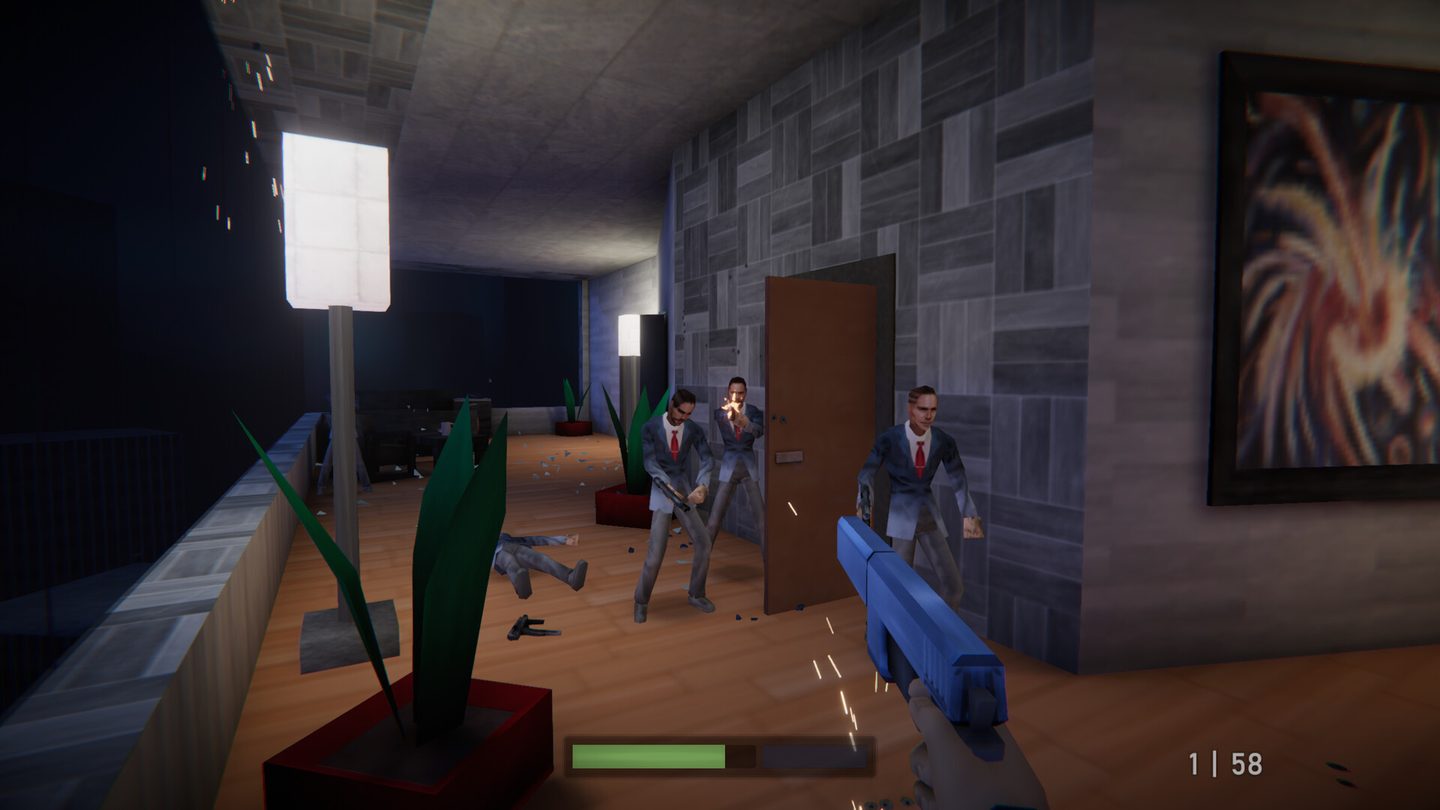
Shoot a GoldenEye guard in the arm and he drops his rifle. Shoot him in the leg and he goes down on it. Shoot him in the chest and he folds backward with both hands over the wound, takes a second, and gets back up if you let him. Every player who put hours into that game in 1997 remembers those guards as unusually smart, and almost nobody who says so is thinking about what the guards were deciding. They are thinking about how the guards fell over.
Replicant D6, the solo developer behind Agent 64: Spies Never Die, spent years rebuilding that feeling and talked to 80.lv on 15 September about how. The phrase from that interview worth taking away is that he prioritised readability over intelligence in combat. That is the correct order of operations, and most modern shooters run it backwards.
The brain was never the point
Guards in GoldenEye respond to roughly four things: being shot, seeing you, seeing another guard shot while that guard is in their line of sight, and hearing a gunshot nearby. That is the sensory model. The behaviour layered on top ran as what the reverse-engineering community named Action Blocks — the scripted per-character sequences that Mitchell “SubDrag” Kleiman’s GoldenEye Editor exposed as editable years before anyone had matching source. A guard walks this patrol, and when input X arrives, runs routine Y.
Written out like that it sounds primitive, because it is. There is no flanking solver in there, no cover scoring, no squad coordination model, nothing a modern AI programmer would recognise as planning. What there is instead is an enormous amount of care spent on the half-second after the input arrives.
That half-second is the entire interface. A guard’s internal state is invisible; the player can only ever see the animation. So the animation set has to carry the whole conversation — noticed you, didn’t notice you, hit in the shoulder, hit in the leg, panicking, reaching for an alarm. Rare spent the budget on the output side, and the input side stayed four rules and a script.
The decompiled GoldenEye source that hit a byte-perfect match last month is useful here for a reason that has nothing to do with PC ports. It preserves the constraint solving rather than someone’s memory of it. And the constraint on a guard was brutal: a few hundred triangles, textures pulled through a 4KB cache, 320x240 on a CRT, fog eating the far half of the room. You cannot read a face. You cannot read a weapon-ready posture from stance alone at that resolution. Silhouette change and timing are the only two signals that survive the trip to the player’s eye, so both had better be doing real work.
What readable costs you
Here is the trade nobody advertises. A genuinely clever enemy — one that picks good cover, suppresses while a teammate repositions, retreats at the right health threshold — will do all of that invisibly, and the player will read it as the enemy behaving randomly. I have watched enough studio AI demos to know the tell: the programmer narrates what the agent is thinking while the footage plays, because without narration you could not tell.
Agent 64 goes the other direction. Guards stagger according to where the bullet landed, roll aside, rush you when you get close, and pile into each other often enough that a clean breach turns into slapstick. Every one of those is legible from across a room with no narration. Whether the underlying state machine is sophisticated is a question the player is never asked.
The structural quoting goes deeper than the guards. The game’s three difficulties are Agent, Special Agent and 64 Agent, against GoldenEye’s Agent, Secret Agent and 00 Agent, and like Rare’s they add objectives rather than only adding enemy health. That is the part of the 1997 design worth copying and the part most retro homages skip, because bolting extra objectives onto a level means the level had to be built with the space for them from the start. Difficulty as a content unlock.
Agent 64 shipped on 11 August 2026 on Steam, at around twenty dollars, from one person.
The same argument, pointed at frame rate
Choosing legibility over fidelity is a decision artists make constantly and rarely get to defend in public. Orbitals animating its characters at 12 and 24fps on purpose is the same call made in a different department: step the output down until the pose reads, then stop. Reviewers split three and a half points over whether that was style or shortfall, which tells you how uncomfortable the choice still makes people.
What the N64 shooters had going for them is that nobody could mistake the constraint for a choice. Four kilobytes is four kilobytes. Now that the hardware will happily render a face you can read, the decision to spend the animation budget on a leg buckling rather than on a subtle micro-expression has to be argued for — and the argument is that the player is standing thirty feet away, moving, and has about four frames to decide whether the man in front of them has noticed.