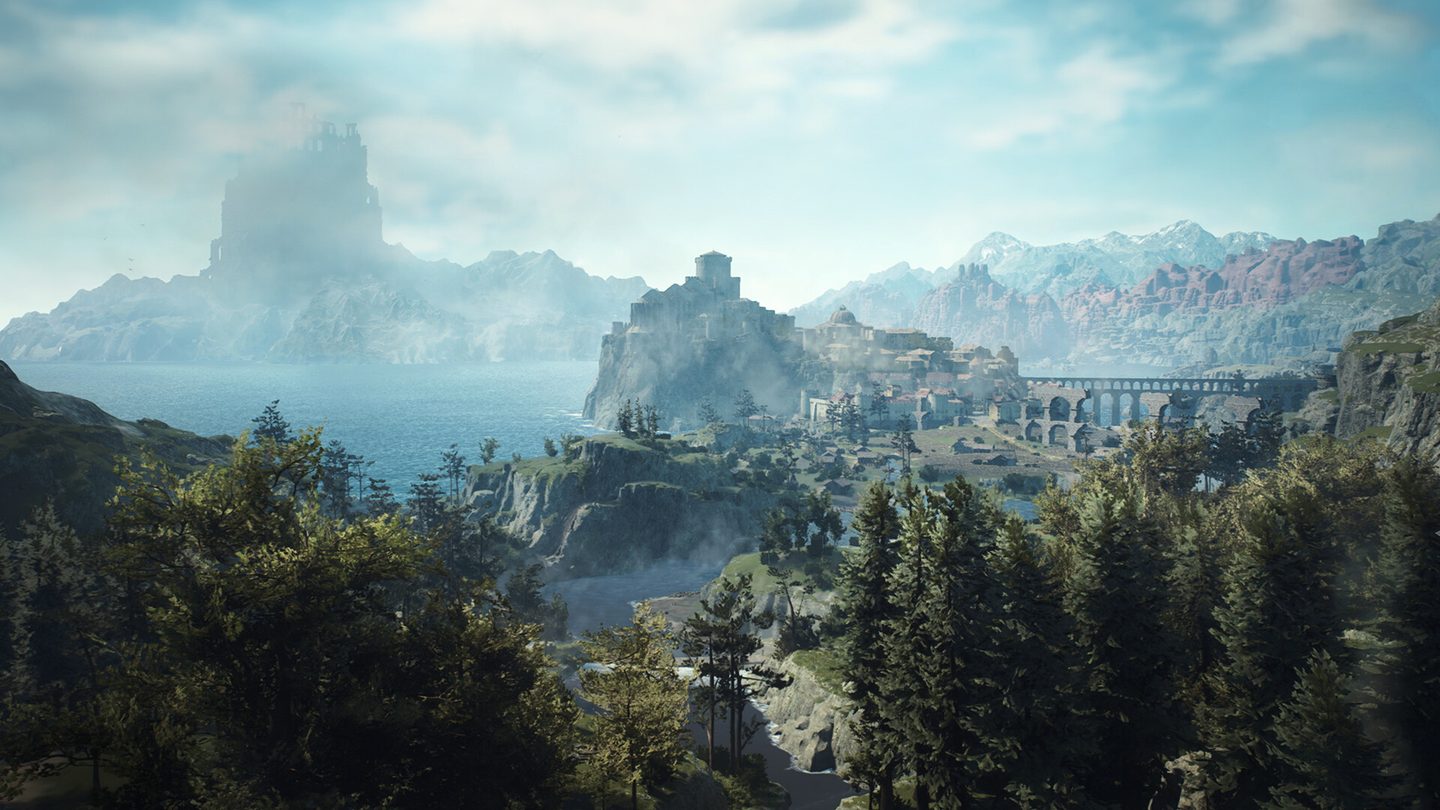
Capcom’s expansion to Dragon’s Dogma 2 arrived today, 9 October, after an early Steam unlock the evening before, and it arrived carrying the weight of the base game’s reception. Dragon’s Dogma 2 shipped in 2024 to an 86 on Metacritic and a 6.5 from users — one of the widest critic-player gaps of that year. Dark Arisen is the answer to it.
Across the eight scored verdicts I could verify today, the average is 8.5. The range runs from 7 to 10. OpenCritic has the expansion at 85 from 34 critics with 91 percent recommending; Metacritic sits at 84 from 21, all positive or mixed, none negative. Both figures as of 9 October, both still moving.
A three-point spread on an expansion is unusual, and it is not spread evenly across the thing. Read the low scores and the high ones next to each other and they agree about the new region, the story, and the combat. They disagree about one system.
The slot machine in the armoury
The expansion adds a loot loop. You find items in the new content, pay Rift Crystals to appraise them, and get Relic gear with randomised passive effects on top. Push Square, which rates the expansion Excellent, still says the equipment grind will not be for everyone. RPGamer’s 3.5 out of 5 points at repetition and pacing. Screen Rant’s 7 is the floor of the sample.
From an art pipeline, that system is a strange thing to add to this game in particular. Dragon’s Dogma 2 authors its armour as discrete sets: a cuirass has a modelled buckle, a weight that reads in the walk cycle, a material response that somebody tuned against the game’s physically-based lighting. There are not many of those, and that scarcity is the point — recognising a piece of armour on another player’s pawn is part of how the Rift works socially.
Randomised affixes undo that. Once the same cuirass exists in forty numerical variants, the player stops reading it as an object and starts reading it as a roll. The appraisal screen becomes the real interface and the armour becomes its icon. Diablo can afford that because its armour is authored to be read at thirty degrees above the character in a 2-inch silhouette. Dogma’s is authored to be read from behind, in third person, at walking pace.
Capcom knew the complaint was coming, judging by how the expansion was pitched: VGC reported in June that it was built “based on wide feedback to the main game”. Feedback asked for a reason to keep playing after the dragon. This is the cheap way to provide one.
Norgan is doing engineering work
The new region is a northern tundra. Reviewers describe whiteouts, and the Steam pre-order bonus is called the Norgan Fashion Set, which is where the name comes from. MP1st filed its review under “Into the Tundra”.
Snow and fog in an open world are almost always a budget instrument. A whiteout is a fog volume with a particle layer, and what it buys you is the right to stop drawing things. Cut the far plane to eighty metres and the LOD chain behind it never runs; the vegetation instancer never populates; the pawn crowd that made Vermund’s cities expensive has nothing to render at distance. You get atmosphere and a frame budget from one decision.
Making it frightening rather than merely cheap is the harder version of the trick. Reviewers put the new region’s best moments there: losing the horizon, then walking into something that was already standing in it. Whether the whiteout is dynamic or scripted to specific stretches of the map, nobody has said yet, and it makes a large difference to what the effect cost to build.
The Switch 2 version is the technical story
Dark Arisen is also Dragon’s Dogma 2’s arrival on Switch 2, and Capcom’s own investor announcement frames the expansion and the new platform as one move to broaden the game’s audience. That matters because of what Dragon’s Dogma 2 was in 2024: a game that fell to the low thirties in its capital on a PS5, pinned there by CPU work rather than by pixels. Every NPC in Vernworth ran a schedule.
The producer told Eurogamer that the Switch 2 build holds a minimum of 30fps and often runs higher, and that performance was exceeding the team’s expectations. Base frame rate is 30 in both handheld and docked, with frame generation producing what Capcom calls a 60fps-equivalent feel.
Which frame generation is an open question right now. Vice reported AMD’s FSR frame generation, which would make this the first Switch 2 title to use it; other coverage describes the pipeline around DLSS, which is what Switch 2’s Nvidia silicon natively offers. Capcom has not published internal render resolutions for either mode. Until it does, or until somebody frame-counts it properly, treat the specifics as unsettled.
What is not unsettled is the shape of the trade. Generated frames interpolate what the renderer already drew; they do not make the simulation tick faster and they do not shorten the path from your thumb to a parry. Dogma’s combat is built on reading a wind-up and answering inside a window. A 30fps simulation presenting at 60 gives you a smoother picture of the same 33-millisecond decision grid.
That is a different bargain from the one CD Projekt struck, where Witcher 3 drops to 720p handheld to pay for its new lighting. Spending resolution on image quality is a trade the player can see and judge. Spending latency on apparent smoothness is one most players will feel without being able to name.
Capcom is in the middle of rebuilding the RE Engine so AI can drive its tools, and the unglamorous half of that project — one data structure instead of a decade of bespoke formats — is the half that makes a four-year-old open world fit on a handheld at all. Dark Arisen is what the plumbing buys.