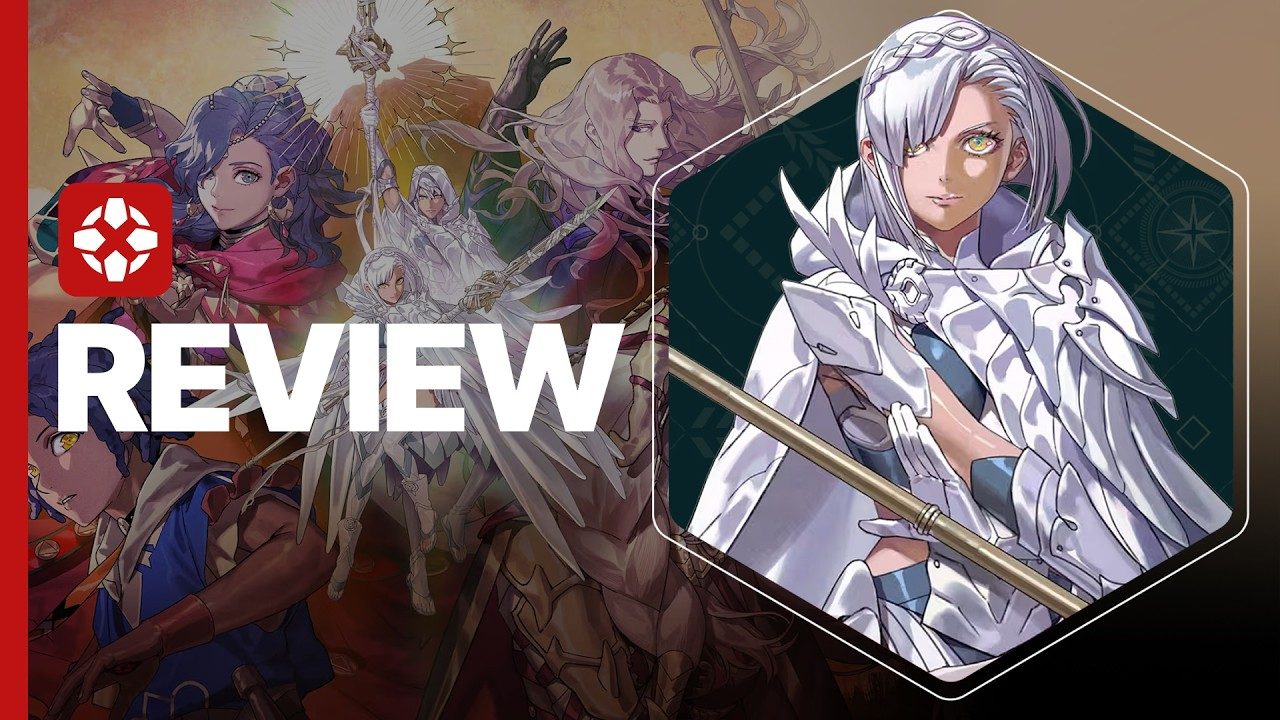
The embargo went up this morning, 16 September, a day ahead of the Switch 2 launch, and the verdicts arrived in a shape worth looking at before the number. Across the nine scored reviews I could verify independently, the mean is 8.8 and the range runs 7 to 10. Metacritic has it at 89 from around sixty critics — it was 53 reviews a few hours earlier, so that count is still climbing. OpenCritic sits at 90.
Eighty-nine is the same figure Three Houses landed on. Awakening is still the series high, which is a thing you will see repeated all week and which matters less than where the three points of spread come from.
The complaints are all about volume
Read the reviews that land at 7 and 8 and they converge, which is unusual and useful. Pacing slips in the later chapters. The hierarchy between the four protagonists gets tangled. There is grindy map management. Too much non-tactical content. The real-time dungeon sections are the weakest thing in the box.
Four protagonists — Cai, Dietrich, Theodora and Leda — carry four mostly separate storylines, and multiple outlets call this the longest campaign the series has shipped. So the thing being marked down is the scope — the sheer quantity of finished game.
That is the expensive end of a production. A branching campaign is close to the worst return-per-hour in this medium: every route needs its own maps, its own encounter design, its own cutscenes, and in a fully voiced game its own recording sessions and its own lip sync. Then most players see one route. You build four times and ship four times, and a single playthrough consumes a quarter of it.
Intelligent Systems have been here before. Three Houses ran three houses and took the same criticism about repetition between them, and it landed on the same 89. Whatever the four-route structure buys in ambition, the reviewing class has now priced it twice at roughly the same number.
Why a tight spread reads differently to a wide one
Three points across nine outlets is narrow. Everyone is arguing about how much of a good thing there is, which is a very different disagreement to the one that opens up when reviewers cannot agree what a game is for.
Six days ago the same exercise on another September release produced seven and a half across a five-point spread, and that gap was the whole story — outlets splitting on whether the thing in front of them was finished. Nothing like that here. The floor is a 7 from a reviewer who found the middle chapters a slog, and the ceiling is a 10 from someone who played all four routes and wanted more.
If you are deciding whether to buy it, the spread tells you more than the mean does. Nobody in this set thinks the game is bad. The disagreement is over how long it runs.
What more pixels cost a cel-shaded look
Nintendo’s own Ask the Developer series has the character designer describing the extra fidelity as a new set of difficulties rather than a free win, and that is the line an artist should stop on.
Cel shading does not improve automatically when you give it more pixels. It is a tolerance game. At a lower resolution the hard step between lit and unlit hides a great deal — a terminator that wobbles across a cheekbone, a line weight that goes inconsistent at grazing angles, an eyelash card that reads as a smudge. Push the same look onto a display with twice the pixels and every one of those becomes visible, and the fix is a rig tuned tighter, a normal transfer that behaves at silhouette, ramps reworked per character instead of shared.
Studios are still finding the edges of this hardware in both directions. FromSoftware went the other way and thinned Limgrave’s grass to hold 30fps, which is the same negotiation seen from the opposite side: decide what the budget buys, then defend it. A stylised game has the easier version of that argument and it still has the argument.
Reviewers describe the battle presentation and the fully voiced cutscenes as beyond what the original Switch could hold, and none of the nine scores I counted docks the game for how it looks. On a series that spent two generations on hardware that could not do this, that is the part I would call the win.
Scores collected on 16 September 2026 from the outlets’ own review pages and published round-ups, converted to a 1-10 scale and averaged, then rounded to the nearest half point. Eurogamer, VGC and GamesRadar+ publish out of five and are doubled here. Giant Bomb’s verdict is reported as 7/10 in aggregations and as four stars out of five elsewhere; at 8 the mean moves to 8.9 and rounds to the same place. The Metacritic and OpenCritic figures are theirs, not mine, and cover far more reviews than the nine counted above.