
Marcus Lehto co-created Halo. He art-directed the original ring, the Covenant, the whole visual language that made a Microsoft launch title look like nothing else on a shelf in 2001. So when he spent a few posts this week picking apart Halo: Campaign Evolved, the remake that launched on PS5, Xbox and PC on 28th July, it carried more weight than the usual remaster discourse.
Most of what he said was generous. He praised the lighting, the Covenant redesign, the Flood. But one line is the one going around: he called the main menu’s shot of the ring “the most offensive thing we see every time we boot up the game,” describing it as looking “like a shiny new toy — out of scale, no mystery, damn ugly,” when it should read as “massive, dark, mysterious, sinister, but also full of wonder.” GamesRadar and others have since reported him walking the temperature down, saying the backlash is overblown even if some choices are “absolutely cringe.” Both things can be true — an artist can have a real, specific gripe and also think the internet took it further than he meant.
I want to sit with the specific gripe, because it is not “I liked the old one better.” It is a complaint with a name, and it is one every environment artist who has ever built something meant to feel ancient has run into.
“Out of scale” is a surfacing problem, not a size problem
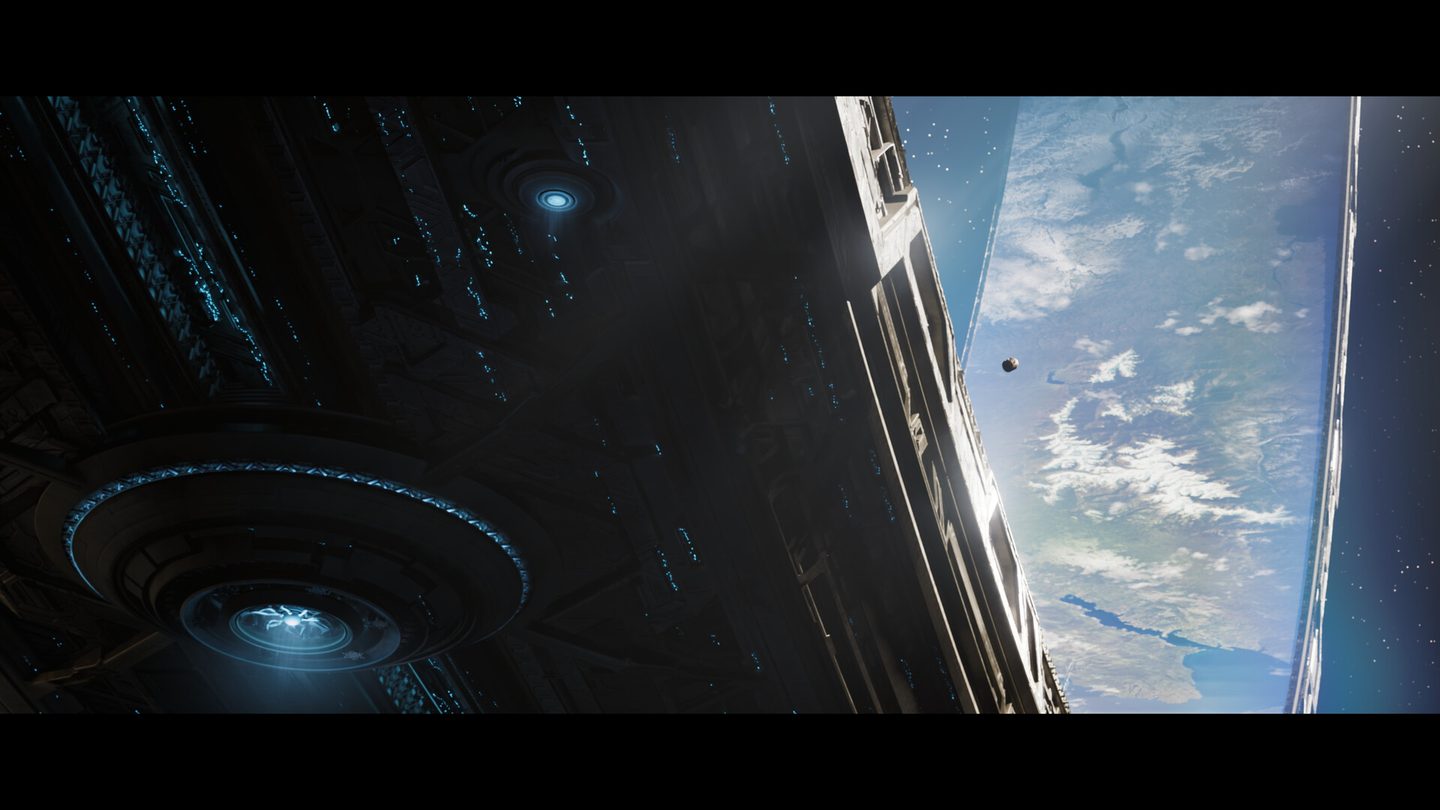
The ring in Halo’s fiction is hundreds of millennia old — a structure that has survived wars, atmospheric decay, orbital debris, entire civilizations. Lehto’s point is that the remake’s version “looks like it was built a few years ago,” and that it “lacks all the micro detail that should give it the epic scale it deserves.” That is about what your eye reads at the surface, because that is what tells you how big something actually is.
This is the oldest trick in environment art, and also the easiest one to lose when a remake prioritizes clarity and readability for a modern audience. Scale is communicated less by the silhouette than by the density of detail sitting on top of it: streaking, panel seams, micro-damage, weathering gradients that change with exposure, moss and dust settling into crevices differently depending on which way is “down” relative to gravity and wind. A clean, evenly-lit surface with a uniform material reads as small and new no matter how big the mesh underneath actually is, because there is nothing at a human texel scale for your brain to compare against. A battleship and a bathtub toy can share a silhouette; what tells them apart is whether there is a rivet line, a rust bloom, a repair patch that does not quite match the surrounding plating.
“Ancient” is a material story before it is a shape story. You do not get there by scaling the model up. You get there by layering enough asymmetric, physically motivated wear that no two square meters of the surface read the same way twice.
Why a remake is more exposed to this than an original
The original 2001 ring worked partly because of hardware limits, not despite them. Low texel density and blurry, low-res textures meant the eye filled in ambiguity with imagination — you could not actually see whether the surface was clean or weathered, so your brain assumed “old and vast” because the fiction told it to. Modern hardware removes that cover. At 4K, with physically based materials and high-frequency normal maps, every surface decision is legible, which means every surface decision is now a decision an artist actually has to make and defend — there is no ambiguity left for the imagination to paper over.
That is what makes Lehto’s complaint sharper than ordinary nostalgia. A remake running on modern rendering has strictly more tools to sell “ancient” than the original ever did — layered decals, triplanar-projected grime, procedural weathering in the material graph, vertex-painted dirt masks that respond to cavity and curvature. If the result reads newer than the blurry 2001 version despite all of that, the gap is not a technology problem. It is a time and reference problem: someone needed more passes of asymmetric damage, more study of what “hundreds of millennia” actually looks like on a surface, and probably did not get the schedule for it on a ring that is mostly a skybox element and a menu backdrop rather than something players walk on for twenty hours.
The part that will actually move
Studios ship, then patch surfacing long after launch — it’s one of the cheaper categories of post-launch polish, because it is texture and material work rather than level layout or code. If 343 or the remake team reads the same complaint Lehto is making — not “make it bigger,” but “give the plating a reason to look five hundred thousand years old” — that is a fixable, bounded piece of work: dirt and streak decals, a weathering-driven material variation pass, maybe a second normal-map layer at a coarser frequency to break up the current uniform panel read. None of that touches gameplay, level design, or the missions people are actually playing for twenty hours. It is exactly the kind of note that gets quietly addressed in a content update three months out, credited to nobody, and solves the actual thing an art director spotted the moment he saw the menu.
Whether that happens is Xbox and the remake team’s call, not mine. But Lehto pointed at the right layer of the problem, which is more than most “this doesn’t look like I remember it” complaints manage. Scale, in this genre, was never really about the model. It’s about how convincingly small imperfections lie about how much time has passed.
One detail worth dating: Lehto’s specific “most offensive thing” quote comes via Eurogamer’s report on his posts; GamesRadar’s follow-up frames the wider reaction as calmer than the headline made it sound. Worth reading both if you want the full temperature, not just the line that traveled.