Hands are where 2D animation budgets go to die. Every frame is a fresh drawing, the shapes are small, the silhouettes read as ambiguous blobs at speed, and a hand that is off by a few degrees stops reading as a hand. So most shows hide them. Pockets, held poses, a cut to the face while the arm does its work offscreen.
CompTown has just announced a show that cannot do any of that.
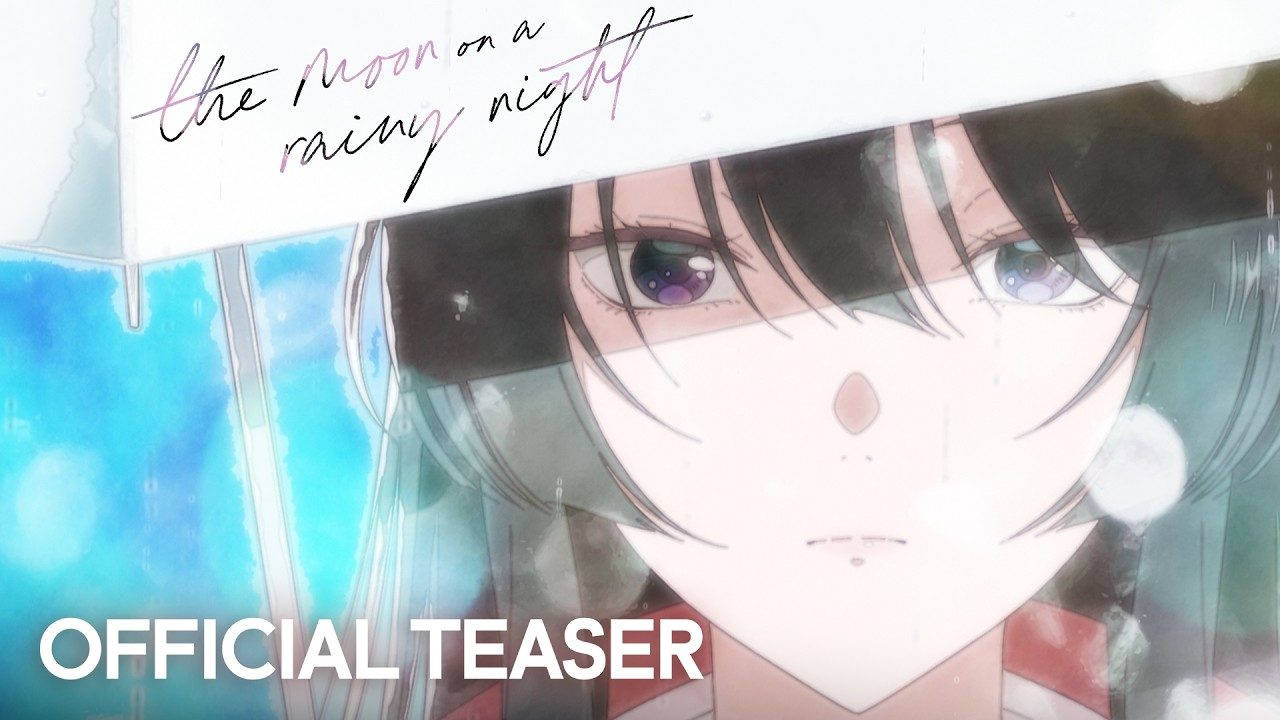
On 7 October the official site for the TV anime of Kuzushiro’s Amayo no Tsuki — The Moon on a Rainy Night — put out its first promotional video and named the main cast. Sora Amamiya plays Kanon Oikawa, who is hard of hearing. Iori Saeki plays Saki Kindaichi, the classmate who approaches her after noticing how the rest of the school handles her. The premiere window is 2027, with no month, no episode count and no streaming partner attached. The manga runs in Kodansha’s Comic DAYS; English-language listings disagree on how many volumes exist, seven in one place and twelve in another, so treat the length as unsettled.
Why signing is not a gesture
A wave is a gesture. You can draw it loosely, hold a cel for three frames, smear the in-between and nobody is harmed. Sign language is a language, and that changes the drawing brief completely.
Four things carry meaning in a sign: the shape of the hand, the way it is oriented, where it sits relative to the body, and the path it travels. Get the handshape wrong and you have produced a different word, or no word. Get the movement path wrong and you have produced a grammatical error, because in Japanese Sign Language, as in every signed language, the motion is doing work that spoken Japanese does with particles and inflection.
Which means the usual economies are unavailable. You cannot hold a cel, because the movement is the sentence. You cannot smear an in-between, because the in-between is a phoneme. You cannot cut to a reaction shot to skip the middle of the motion — the middle of the motion is the dialogue, and cutting away is the animated equivalent of muting a line and leaving the subtitle up. You cannot loop a cycle, because nobody says the same thing twice.
A deaf viewer notices all of it immediately, in the way a Japanese speaker notices a mispronounced word. For everyone else it registers as a vague discomfort they cannot name, which is arguably worse, because it reads as bad animation rather than as a mistake.
The credit that is missing
The December 2025 announcement gave the core team. Tomoe Makino directs, off Aharen-san wa Hakarenai. Shogo Yasukawa handles series composition and scripts, off Shokugeki no Soma. Character design is Ayumi Nishibata, who did Otherside Picnic. Music comes from jizue, a Kyoto band, which is an interesting choice for a show about someone who does not hear the way the audience does.
This week’s video added the next layer: assistant directors Seung Deok Kim and Tsutomu Tomoyuki, colour key Haruko Nobori, art director Mai Ichioka, compositing director of photography Atsushi Satō, editor Masahiro Gotō, sound director Nobuyuki Abe. CompTown’s president Masao Yamamura takes the animation producer credit.
Neither list names sign-language supervision — 手話監修, the credit a Japanese production uses for it. That may simply mean it has not been announced; studios reveal staff in layers and this is only layer two.
But it is the credit worth watching for, because of what it buys. An animator who does not sign cannot invent a correct sign, any more than a letterer who does not read Arabic can invent correct Arabic. The supervisor is not a consultant brought in to check the work afterwards. They are upstream of the drawings, deciding what the reference footage contains, and the reference has to exist before anyone keys a scene.
The reference point here is A Silent Voice, Kyoto Animation’s 2016 film, which is why it keeps coming up whenever this material does. Naoko Yamada has described getting direction on every aspect of the signing — the meaning, the reasoning behind it, and how it looked — running from pre-production through post. That is a structural arrangement, not a courtesy credit, and it is the reason the JSL in that film is held up as accurate rather than decorative.
Two ways out, both expensive
There is a route that guarantees fidelity, and the blog has already looked at it: the live-action Look Back handed a sequence to a rotoscope director rather than trusting key animation to carry it. Rotoscope solves hands by refusing to invent them. Shoot a signer, trace the result, and the handshapes are correct by construction. It also looks like rotoscope, which is a strong stylistic commitment to make on a school romance, and it is slow.
The other route is 3D hands, posed on a rig and rendered to match the 2D. On paper it is the obvious answer — build one hand, reuse it forever. In practice the saving tends to evaporate, which is the whole finding of what Studio Orange does: every trick that makes CG read as anime costs back the asset reuse that 3D was supposed to buy. Hands are the worst case for that, because the corrections anime demands — the slight slide of a shape, the line weight, the redrawn frame when the silhouette goes muddy — land hardest exactly where the detail is finest.
So the likely answer is the unglamorous one. Good reference, a supervisor, and a lot of ordinary key animation done carefully, with the signing scenes budgeted as the expensive sequences they are and the rest of the show paying for them.
The mix is a problem too
Naming a sound director early is a hint, and the hint points at something real. A story told partly from inside the head of a hard-of-hearing character has a mixing problem, and the cheap solutions are all bad. Muffle everything and you have a gimmick that gets tiresome in two episodes. Drop to silence and you have flattened a range of hearing into a binary. Partial hearing is frequency-shaped rather than volume-shaped, which is a far more interesting thing to build in a mix and a much harder one to sustain across twelve episodes.
Abe has the first chance to decide how often the show sits in Kanon’s hearing at all, and that decision shapes the animation too, because a scene the audience hears from inside Kanon needs the signing legible on screen without a single spoken line propping it up.
A premiere window two years out and a credit list still filling in. The next staff reveal is the one to read.