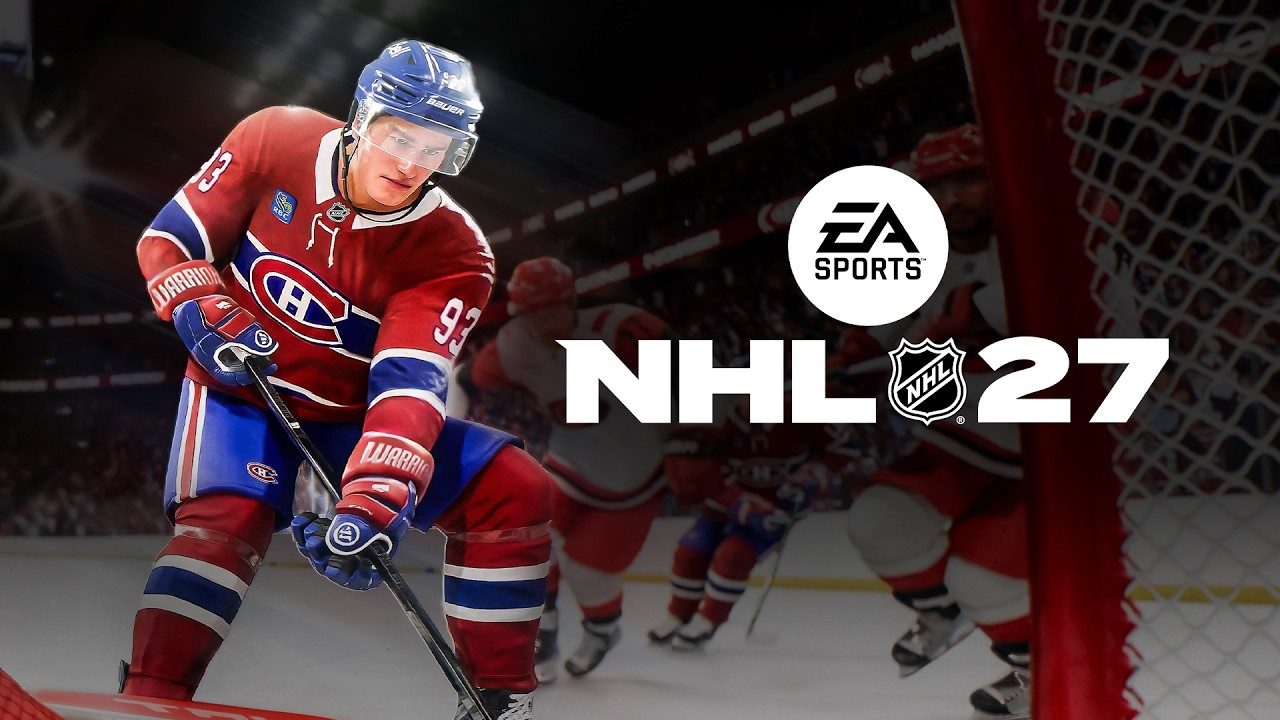
The way most people found out that NHL 27 ships generative AI voice was a podcast. John Buccigross, the ESPN broadcaster who is one half of the game’s new commentary booth, mentioned it on the Chirping Zebras Podcast as though it were common knowledge — EA had played him lines in his own voice that he had never recorded, and he thought they sounded pretty good. His summary of the arrangement has been quoted everywhere since: if it means less work and the same cheque, he will take it.
EA confirmed it afterwards. The company says it used AI voice technology to expand recordings from Buccigross and Darren Pang, with their full consent and active collaboration. Nobody disputes the consent. What nobody announced was the feature.
The numbers, and how far apart they are
NHL 27 came out on 11 September on PS5 and Xbox Series X|S — no PC version, full price, with the Deluxe edition opening seven days early on 4 September.
I can find seven scored verdicts. Analog Stick Gaming gave it 8. The Games Machine gave it 7.9. Athlon Sports and HackInformer both gave it 7. Game Informer gave it 6.5. Shacknews gave it 6. DualShockers gave it 5, calling it a shell of what the series was a decade ago. The mean is 6.77, which rounds to 7 here.
Read the spread rather than the mean. Three points between the top and bottom verdict is enormous for an annual sports release, where the usual shape is a tight cluster half a point wide because everyone is grading the same small delta against last year. IGN filed without a number I could confirm, and described the series as stagnating.
My seven skew high against the wider sample. OpenCritic has it at 64 across thirteen critics, rated Weak, in the bottom quarter of everything they track, with 31% of critics recommending it. Metacritic sits somewhere near 68. So treat the 7 as the generous end of the room, and the 31% as the honest middle of it.
Presentation was the pitch
The August deep dive sold this year almost entirely on presentation: a graphics package rebuilt to match how hockey looks on television now, team-authentic goal songs, thirty-two team-specific playbooks where previous years shared three global strategies between every club, and Connected Franchise back after a long absence. That is a real list. A lot of it is craft work that fans had asked for.
Reviewers went after the presentation overhaul. Several of the more positive verdicts single out the on-ice gameplay as improved, so the skating and the physics come out of this fine. The complaints land on the layer that was supposed to be the headline, and inside that layer they land hardest on the audio.
This is the part worth sitting with if you build anything that has to read as broadcast. A television presentation works as a timing system, and you cannot upgrade it one asset at a time. The lower-thirds, the replay wipes, the crowd bed, the way a commentator’s pitch rises a quarter-second before the puck crosses the line — those things carry the illusion together, and the audio does more of the lifting than the graphics do. You can rebuild every overlay in the package and still have the whole thing read as a video game the moment the voice over the top of it arrives flat and late.
Reviewers described the Buccigross and Pang booth as low-energy and thin. Some of that is a first year for any new commentary pairing, which is always rough — the chemistry is recorded separately and assembled, and two broadcasters who sound great calling a live game can sound like strangers when the lines are cut apart and reassembled by a game engine. But a synthesised line has a specific failure mode on top of that, and Buccigross himself gave the clearest example of it: the model said chairs where a hockey broadcaster would say seats.
That is the whole problem in one word. The generated audio is technically clean. It scans as his voice. And it gets the vernacular wrong in a way no hockey fan will miss and no spectrogram will catch. Anyone who has shipped a generated texture or a retargeted animation knows this shape — the asset is ninety-five per cent right, and the five per cent is precisely the part the audience is expert in.
Two annual sports games, one month
The comparison sitting right there is NBA 2K27, which this blog looked at on 2 September and scored 8.5 off a much thinner sample. The praise there went to defence built from footage broadcast cameras barely show — a team that went and solved a presentation problem the hard way, by finding reference nobody had bothered to shoot properly. Same genre, same annual treadmill, same broadcast ambition. One of them spent the year on the part nobody could fake.
There is also a licensing angle that is starting to look prescient. When Saber’s Space Marine 3 confirmed last week that Games Workshop’s licence forbids generative AI outright, it read as a rights-holder being cautious. A week later, the loudest complaint about a full-price sports sim is a voice track that was expanded with exactly that technology, disclosed by accident. The NHL and NHLPA licences evidently permit it. Whether the next round of negotiations still does is a different question.
Where that leaves it
A 7 off seven verdicts, on a range from 5 to 8, describing a game that plays better than it presents in a year sold on presentation. If you play hockey games you have made this calculation before and you will make it again next September.
The genAI disclosure is the part that will outlast the score. The voice lines themselves are hardly a scandal — the broadcasters agreed, got paid, and one of them is openly pleased about the reduced studio time. What sticks is that a full-price annual release shipped a synthesised performance inside its headline feature without saying so, and the first person to mention it was the man whose voice it was.