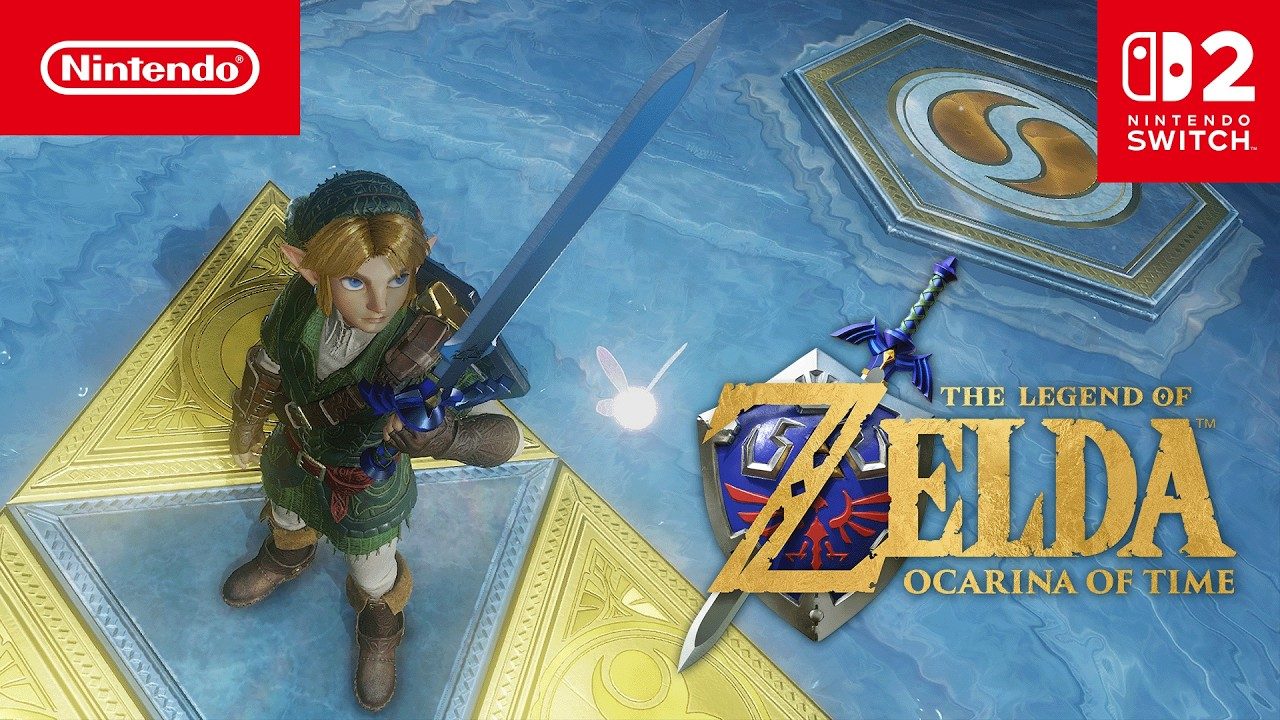
Nintendo shipped The Legend of Zelda: Ocarina of Time on Switch 2 on 5 November and said the game was built in house, by Entertainment Planning & Development Production Group No. 3. Four days later two other companies published pages on their own sites saying what they had made for it.
Bandai Namco Studios describes partial production of artwork and visual assets for the remake: characters, terrain, animations, cutscenes and UI. Monolith Soft lists partial contract development covering game design, programming and graphics — its fifth mainline Zelda, going back to Skyward Sword in 2011. In the game’s own credits, which you reach by finishing the story, Monolith Soft appears under Special Thanks.
Read that asset list again, slowly. Characters, terrain, animations, cutscenes, UI. Those are five departments in any studio I have worked the kind of hours in, each with its own pipeline, its own naming conventions, its own argument about where the rig ends and the animation begins. Handing all five out is commissioning the art.
Specifying a look is the expensive part
The assets are the easy half of outsourced art. What Nintendo had to produce first was a document precise enough that a team in another building, on another engine branch, could make Hyrule Field and have it come back looking like Hyrule Field — the fog falloff, the grass density, how far Link’s silhouette reads against a hill at dusk, which of the 1998 decisions were taste and which were the N64 talking.
My earlier piece on this remake took Nintendo’s line at face value and treated the rebuild as the work of the team that missed 1998 — EPD Group No. 3 deciding what Hyrule looks like rather than a port house. I still think that is where the decisions were made. The disclosure moves where the hands were, which is a different question, and a more interesting one.
Because EPD Group No. 3 is the Breath of the Wild and Tears of the Kingdom team, and that team is not idle. Whatever they are building next, they were building it through 2026. A full asset rebuild of a 1998 game needs a hundred people for a year who do not exist on that org chart, and the capacity came from outside. That is the honest reason a remake of this size arrived on this schedule, and it is the same arithmetic behind what a Switch 2 port costs the art team when the deadline is fixed and the hardware is not the one the assets were authored for.
Special Thanks
Here is what bothers me. Bandai Namco Studios and Monolith Soft both told the world about this work themselves, on their own corporate sites, days after launch. They are not in a position to put a logo on the title screen. So the credit that reaches the person scrolling past at two in the morning is a line under Special Thanks, next to the catering.
This is normal in Japanese co-development and it has been normal for twenty years. Normal does not make it fine. An artist’s credit is their portfolio; “Special Thanks, Monolith Soft” does not tell a hiring lead that you modelled the Gorons. The studios disclose it on their own websites precisely because the credits do not, which is a workaround, and workarounds leave the junior people out. Nintendo’s own Ask the Developer interviews name its internal staff generously. The asymmetry is the point.
I cannot tell you who did which part. Monolith Soft says graphics, Bandai Namco says artwork and visual assets, and those two phrases could describe the same work or completely different halves of it. Nothing I have read names Grezzo, the studio that made the 3DS version of this game and the Link’s Awakening remake, so whether they touched this one at all is unconfirmed. The sources also disagree on billing: some coverage calls Monolith Soft a co-developer, the credits say Special Thanks, and both are accurate depending on which document you trust.
What is settled is the shape. Nintendo specified it, and a lot of the pixels were made somewhere else.