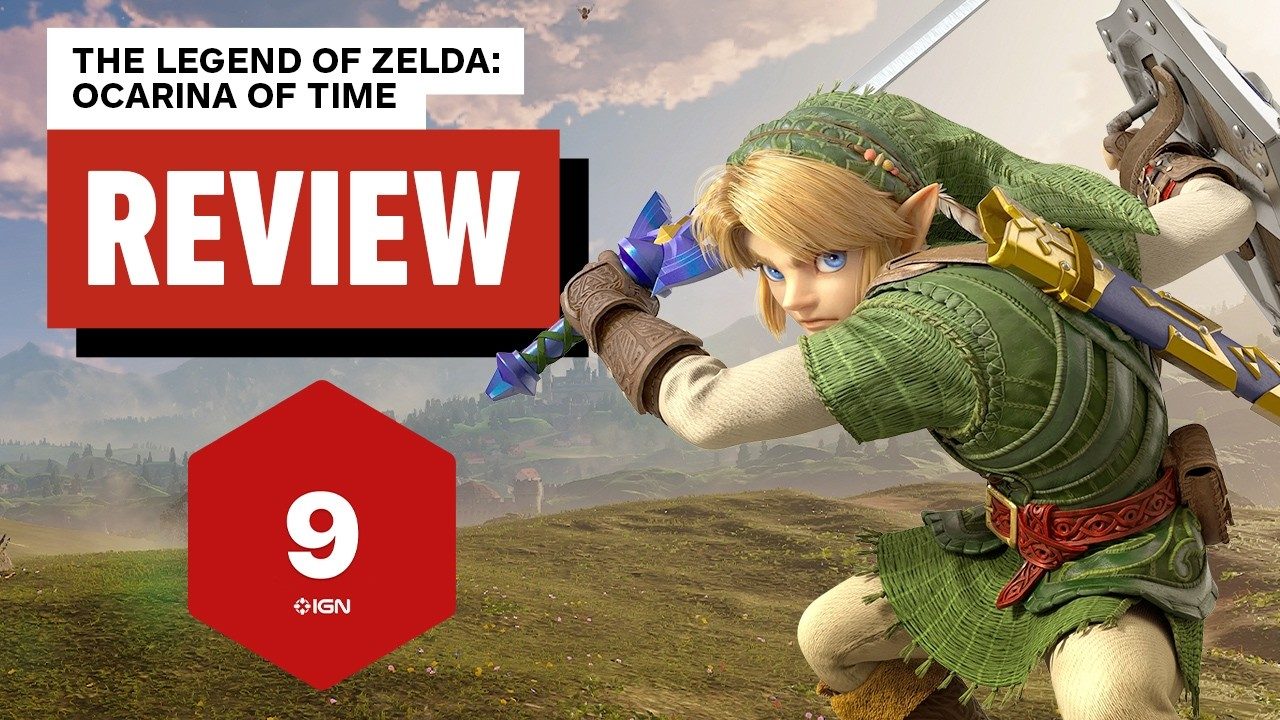
Reviews for The Legend of Zelda: Ocarina of Time went up on 4 November 2026, the day before the Switch 2 remake shipped. Nine of them, converted to a ten-point scale, average 9.5. The spread is one point — 9 at the bottom, 10 at the top, nothing below. Metacritic sat at 96 on launch day across seventy-odd critics, which made it the best-reviewed game of 2026, and OpenCritic has it at 95 across 69.
A one-point range on nine verdicts is unusual enough to be worth saying out loud. Phantom Blade Zero managed a four-point spread last month. Critics disagreeing is normally where a review round-up gets interesting, and here they do not disagree about anything except how much ambition they were owed.
The comparison everyone reached for is the 1998 original’s 99, still the only 99 Metacritic has ever recorded. That number rests on 22 reviews. The remake’s 96 rests on roughly four times as many, which is not the same measurement taken twice, and the gap between them says more about how many outlets existed in 1998 than about either game.
The two things I wanted pinned down
Before launch I wrote about the team that missed 1998 — Aonuma handing the revision decisions to staff with no memory of the N64 release — and ended it with two production questions. What happens to Hyrule Field, whose emptiness started life as a draw-distance budget and turned into the game’s sense of scale. And how you load a voice performance onto faces that were, in 1998, a texture on a flat plane.
The reviews answer one and a half.
On the field: Video Games Chronicle says the remake sticks closely to the original’s design, unlike the other big nineties remakes of recent years, and Forbes reports much of the level design kept intact. Vooks found some dungeon puzzles and room layouts altered, which is the limit of it. So the field is still the field. Nobody I read treats its emptiness as a problem, and nobody says it was re-lit either, so whether anyone made a decision about it or simply left it alone is still open.
On the faces: they limited the problem. Nintendo Life describes voice acting in key cutscenes rather than throughout, and rates it among the better first-party Nintendo performances in a while. That is a scoping answer and a good one. You do not rig every NPC in Kakariko for lip sync. You pick the two dozen shots that carry the story, build real facial rigs for those, and leave the rest of the cast doing what they did before.
What they did change
Forbes lists a free-form camera and a real jump button. Both of those are bigger jobs than they sound on a game designed around their absence. The 1998 jump was contextual because the N64 pad had four C buttons and one stick, and every ledge in the game was authored knowing the player could not miss. Put a jump button on it and somebody has to walk the whole geometry again checking what is now reachable.
The camera is the same kind of work. Z-targeting existed partly because there was no second stick to look around with, and every corridor in every dungeon was framed for a camera that behaved a particular way. Hand the player free look and you are re-checking sightlines in rooms that were composed as single-angle stages.
Combat stayed as it was, per Forbes. The interface went to the Breath of the Wild and Tears of the Kingdom item wheel, per VGC.
Caution is what an outsourced spec looks like
Here is the part that interests me, and it connects to the thing that came out four days after launch. Bandai Namco made the art — characters, terrain, animations, cutscenes and UI, by its own account, with Monolith Soft on game design, programming and graphics.
Think about what you have to write down to commission that. A spec precise enough that another company can build Hyrule Field and have it come back looking like Hyrule Field is, by necessity, a description of a game that already exists. Every element you want reconsidered is an element you cannot specify, because nobody knows yet what it should be. So the brief describes 1998, closely, and the conservatism the reviews flag is baked into the procurement before an artist touches it.
This is procurement doing what procurement does. Nintendo wanted a canonical text rebuilt at modern fidelity by partners, and wanting that rules out the version where the dungeons get re-thought.
Nintendo Life’s verdict — stunning, not quite definitive — is the one I would have filed. No Master Quest, and a remake of the most canonised 3D game ever made that declines to argue with it.
The 9.5 is real. Nine critics, nobody under 9, and a game that looks better than anything else on the hardware. Whether a remake this faithful was the thing worth spending a hundred artist-years on is a different question, and the scores were never going to answer it.