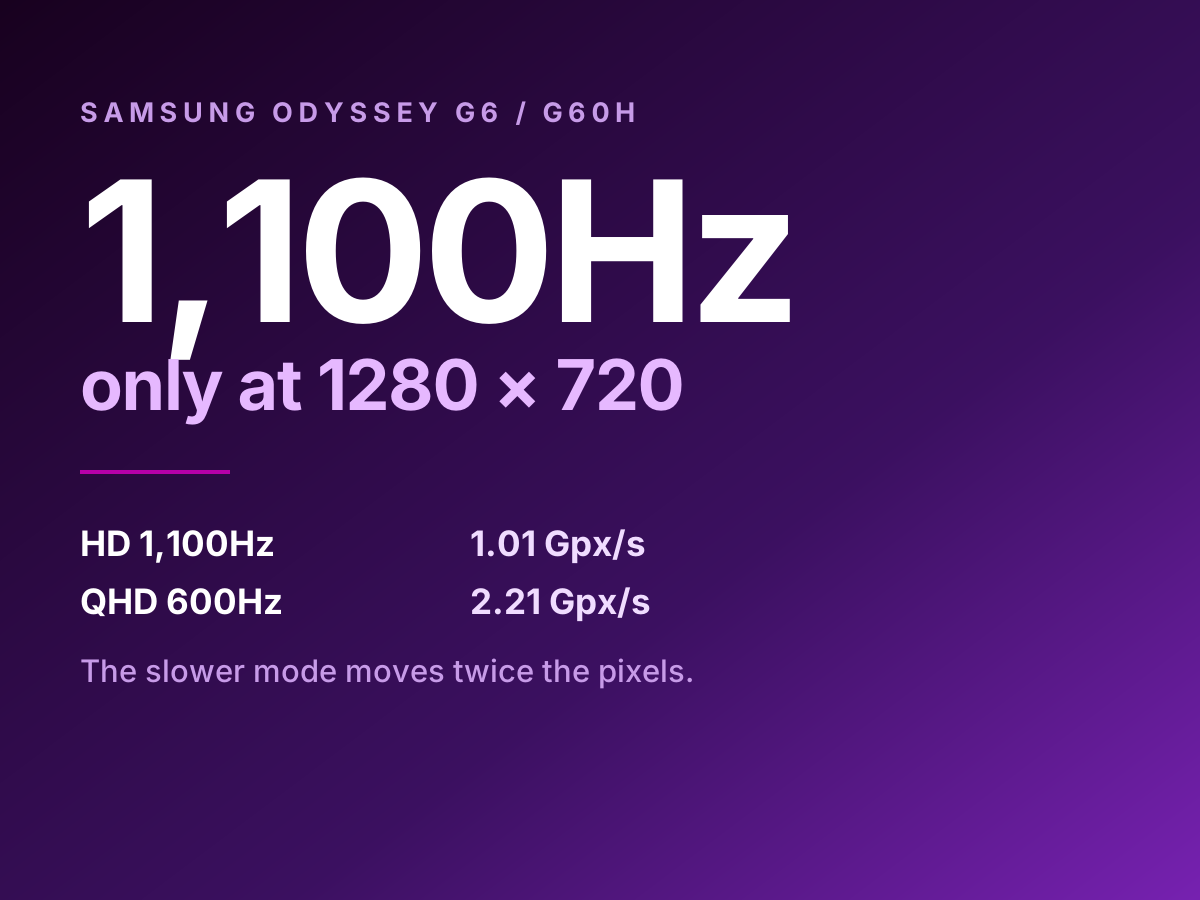
Do the multiplication first, because nobody covering this has.
The Odyssey G6 in HD mode: 1280 × 720 × 1,100 = 1.01 billion pixels a second. The same monitor in its native QHD mode: 2560 × 1440 × 600 = 2.21 billion. The mode with the smaller headline number moves more than twice as much data.
Samsung introduced the 27-inch G6, model G60H, on screen during its Gamescom keynote on 27 August, alongside the OLED G9 and OLED G7 that got the stage time. Fast IPS panel, rated 1ms response, up to 1,100Hz at HD and up to 600Hz at QHD through Dual Mode. Ahead of CES this year the spec was 1,040Hz. They raised it. It ships globally in the second half of 2026, which makes it the first of the 2027 Odyssey line to arrive.
What the number actually buys
Refresh rate stopped being about input lag a long time ago. On any sample-and-hold display — every LCD, every OLED you can buy — a frame is painted and then held there for the entire frame interval. Your eye does not hold still with it. When you track something moving across the screen your gaze slides smoothly while the image sits frozen, and the held frame smears across your retina by however far the object should have travelled during the hold. The holding is the blur.
So the blur is the frame time, in pixels of motion:
| Refresh | Frame held for | Smear on a 1000 px/s object |
|---|---|---|
| 60Hz | 16.67ms | 16.7 px |
| 240Hz | 4.17ms | 4.2 px |
| 600Hz | 1.67ms | 1.7 px |
| 1,100Hz | 0.91ms | 0.9 px |
Which is where the enthusiasm should start cooling. Going from 60Hz to 240Hz removes twelve and a half pixels of smear, and you feel it immediately. Going from 600Hz to 1,100Hz removes another three quarters of one pixel. On a 27-inch panel that is a distance smaller than the anti-aliasing already sitting on the edge you were looking at.
The curve is hyperbolic. Past a point you pay a great deal for its tail.
Nothing here explains the 720p
Here is what I cannot make add up. If the panel can push 2.21 billion pixels a second in QHD, throughput is not what stops it at 1,100Hz in HD, where it only needs 1.01 billion. Line rate does not explain it either: QHD at 600Hz scans 864,000 lines a second, HD at 1,100Hz scans 792,000. The mode Samsung calls the world’s first 1,100Hz is doing less work, on both measures, than the mode sitting next to it in the menu.
Something else sets that ceiling — minimum frame timing in the scaler, a firmware limit, a driver IC that will not clock past a point, or simply a number chosen because it sounded better than 1,000. Samsung has not said which, and I am not going to guess in public. It is worth flagging that the trade-off being sold here as a bandwidth compromise does not look like one.
Then there is the response time. A rated 1ms transition inside a 0.91ms frame means the liquid crystal has not finished settling before the next frame is already due. That figure is a manufacturer’s best case — grey-to-grey, overdrive on, measured the way that produces the smallest number — so the real transitions are slower than the frames they are meant to display. Whatever motion clarity you measure on this panel at 1,100Hz will land short of the arithmetic above, and the gap is the panel chemistry, not the signal.
The frame budget from the other side
Working in engine, 0.91ms is the entire budget. Everything: culling, the draw submission, shadows, whatever post you failed to cut. A frame landing in under a millisecond is one where the CPU has done almost nothing between submissions.
At 720p on low settings a competitive shooter with a deliberately cheap renderer will run into the high hundreds on current hardware, and those are exactly the games this monitor is aimed at. Eleven hundred is a further stretch. Frame generation will not bridge it either, because interpolated frames carry no fresh input, and fresh input is the thing the audience for a 1,100Hz panel says it cares about.
Which leaves the mode people will actually run. QHD, 600Hz, native resolution, 1.7 pixels of smear, and the higher pixel rate of the two by a factor of more than two. That is a very good monitor. The number on the box describes the other mode.
Specifications from Samsung’s Gamescom 2026 Odyssey announcement, 27 August 2026, as carried in its global newsroom; the newsroom page itself was not reachable from here, so the figures are taken from the quoted text in that release. Pixel rates, line rates and persistence figures calculated from those specifications. Samsung has not stated what limits the HD mode to 1,100Hz.