Undead Labs completed its separation from Xbox on 22 September and posted the layoff news the same day, hours apart. That interval is the detail worth sitting with.
The studio is independent now and employee-owned. It keeps State of Decay, keeps the back catalogue, and by its own account leaves with funding to carry it for a while. It did not say how many people are going, only that the number is significant and that some of them were working on State of Decay 3. It now needs a new publisher, and the game is still promised on Game Pass day one, which is an odd pair of sentences to read together.
Ninja Theory got the other outcome from the same announcement — closure consultation opened on 22 September, 268 roles cut across the restructure. Divestment is the better of the two doors, and it still put people out of work this week.
Why the cuts landed on day one
Runway funding is a number. Burn rate is headcount multiplied by time. Divide the first by the second and you get a team size, and that arithmetic does not improve by waiting six months to do it.
While the studio was first-party, payroll was somebody else’s line item and the question was how many people the project needed. From 22 September it is the studio’s own money, and the question inverts: how many people can the money hold until a publisher advance arrives. Anyone who has watched a small studio take over its own books knows the answer arrives on the first day, because every month you delay is a month of runway spent on a headcount you were always going to have to cut.
So the timing is a spreadsheet being solved the moment it becomes solvable.
The plumbing nobody credits
Leaving a first-party umbrella costs you things that never appeared on your budget. Build and test farms. Automated capture running on real retail hardware overnight. Certification and submission handling. Localisation. Accessibility review. Playtest recruitment and the people who read the results. Shared engine support when Unreal does something unexpected in a build.
None of that is creative work, which is why it is invisible in every article about a studio going independent, and all of it has to be replaced by somebody. In a shrinking team that somebody is usually an existing senior — a lead environment artist who now also owns the build pipeline, an engineer who now also owns submission. The hours come from the same place they always come from.
Where a smaller team shows up in an open world
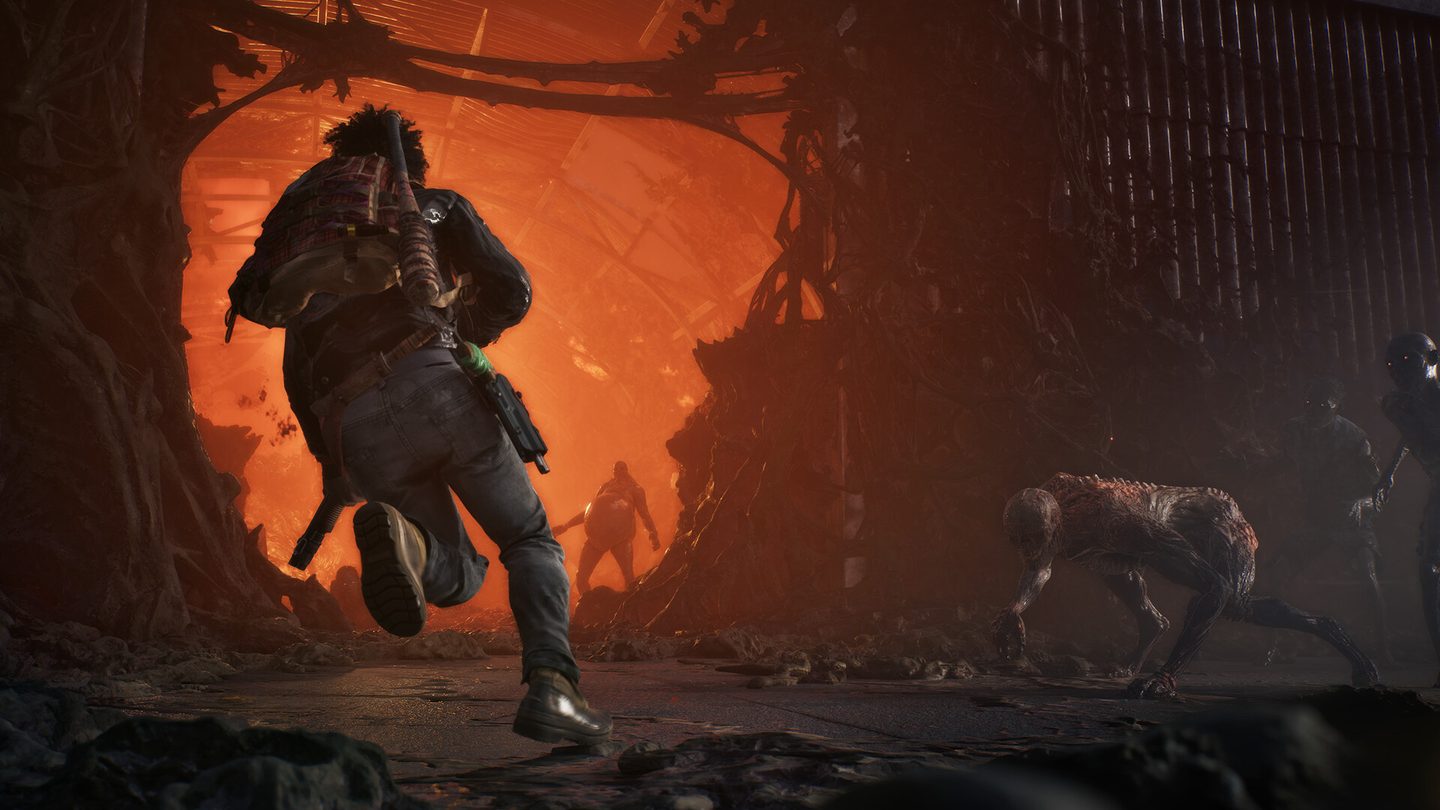
The June reveal put numbers on the thing. First proper gameplay at the Xbox Games Showcase on 7 June 2026, built in Unreal Engine 5, a map around four times the size of a single State of Decay 2 map, shared-world co-op for up to four players, targeting 2027 on Xbox Series X|S, PC, cloud, Steam and PS5. Undead Labs said the footage was game capture rather than CGI, logo aside.
A map four times the size is four times the fill. Interiors that have to be enterable because this is a looting game. Props with wear passes, because a house nobody has lived in for two years reads wrong if the dust is uniform. LODs, streaming cell tuning, collision that holds up when a player drives a truck through it at an angle nobody planned for.
That work scales with people almost linearly. Systems work does not — one engineer can redesign a melee system and the design holds at any map size. Cut environment artists from an open-world project and the map does not get smaller. The density drops, or the schedule slips, or a region ships greyer than the vertical slice promised.
Co-op multiplies it again. Four players in a shared world means four cameras in four districts, so the streaming budget you tuned for one viewpoint gets split, and the memory headroom that let you push texture resolution in a single-player build quietly disappears. Every art decision has to survive being looked at from four places at once.
This is the same reckoning Polyarc ran into with the art discipline Moss was built on, from the other end: there, a specialism was exactly right for a platform that stopped funding it. Here a content pipeline sized for publisher money has to keep producing on studio money.
The schedule is the open question
The game is in alpha, with a closed beta said to be planned before the end of 2026, shipping in 2027. Alpha is a comfortable word that covers an enormous amount of remaining work — the polish tail on an open world is where most of the hours live, and it is the phase that eats artists rather than designers.
Three things are unconfirmed and all three matter more than the headline. How many people actually left. Who publishes it. Whether 2027 survives contact with both answers.
The Game Pass day-one commitment is the strange survivor here. A studio with no publisher signed is still holding a distribution promise on a platform it no longer belongs to, which suggests Microsoft’s side of the divestment included more than a cheque and a handshake. Nobody has said what.
Separation date, employee-owned status and the layoff wording from Undead Labs’ own LinkedIn post of 22 September 2026 and Game Developer’s report on it. State of Decay 3 platform, engine, map-scale and co-op details from Xbox Wire’s gameplay-reveal post of 7 June 2026. Layoff headcount, the new publisher and any change to the 2027 window are unstated at the time of writing.