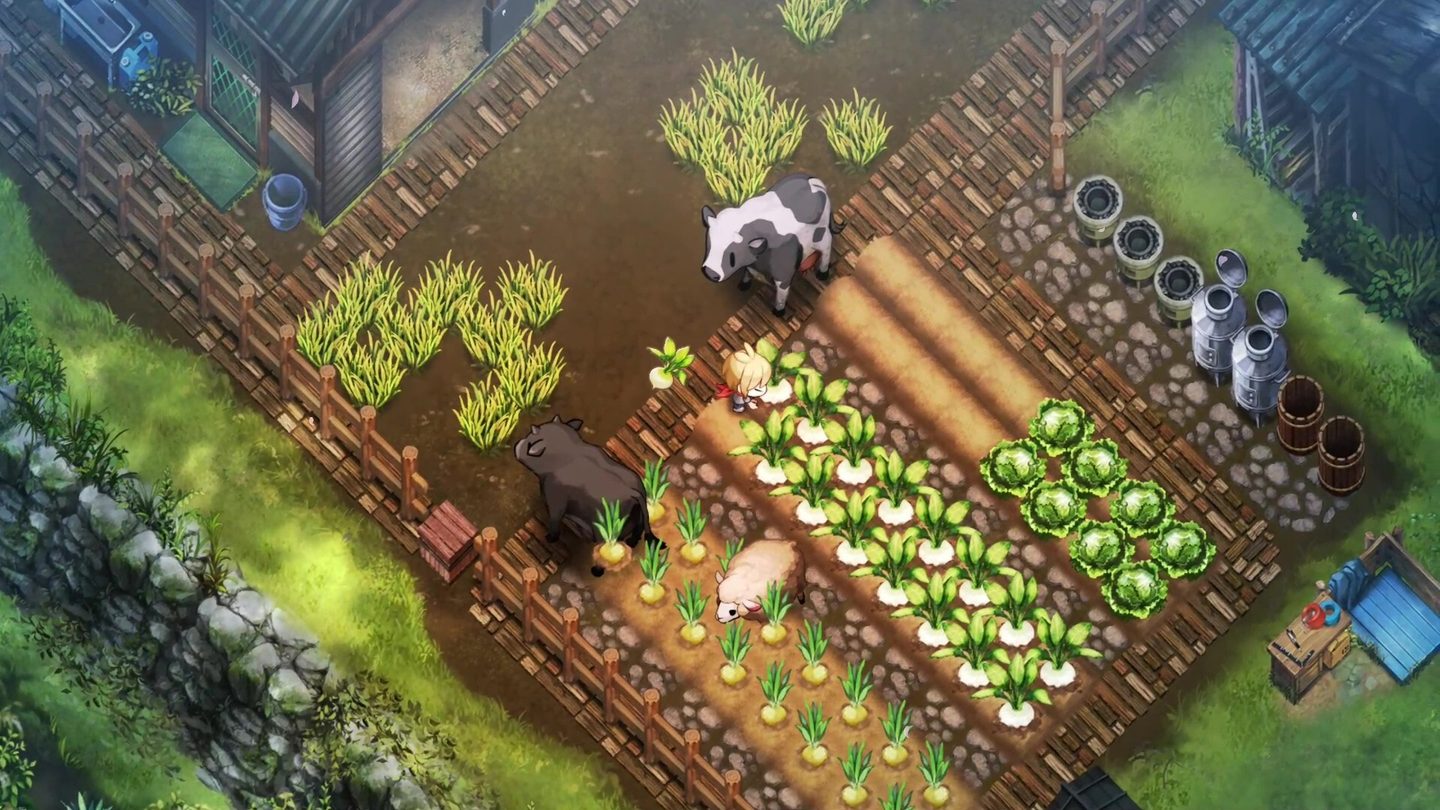
There is a switch in the options menu. Shade Mode gives you the whole game: a village, a farm, a curfew, and nights you are supposed to be afraid of. Sunshine Mode takes the horror out and leaves the farming. Same village, same neighbours, same crops, no reason to be indoors by dark.
Most studios would have shipped that as two games, or more honestly as one game and a difficulty slider. Nippon Ichi made it a mode. So the village has to survive being read twice.
Village in the Shade came out in Japan on 30 July 2026 and in the West on 27 October, published outside Japan by NIS America, on PS5, Switch, Switch 2 and PC. That three-month gap is why scores for it have been landing since the summer in two separate waves, and why its aggregator pages look like they have dates wrong when they do not.
The numbers
Across the ten scored verdicts I could verify, the average is 8.5. The range runs 7.9 to 9.5 — RPGFan at 95 out of 100 at the top, NoobFeed at 79 at the bottom. OpenCritic sits a little higher, around 89 from 26 critics, with roughly five in six recommending it. Metacritic’s 85 comes from a much smaller sample, eleven reviews, and it splits by platform: 89 on Switch 2, 87 on PC, 84 on PS5.
A 1.6-point spread is tight for a game this strange. Nobody in that range argues about the premise and nobody argues about the art. The disagreement is narrower than that. It is about how long the thing takes to get going, and how much it bothers to explain itself.
Nippon Ichi has been building for this for twenty years
RPGFan’s reviewer scored the graphics a hundred out of a hundred. On a Nippon Ichi game that is worth stopping on, because this has never been a studio that buys fidelity. Disgaea, Yomawari, the Labyrinth games — the look in all of them comes from committing hard to a style and keeping polygon and texture budgets somewhere a small team can actually finish them.
That economy is what makes a removable horror layer affordable. The same discipline shows up whenever a small team has to make a specific mood legible instead of expensive — it is the same problem as making convincing bad craftsmanship read as bad on purpose, where the art has to say something precise with very little geometry to say it with.
Sunshine Mode is the harder sell, and the one that tells you whether the village was built properly. Strip the dread and you have crops, a calendar and some neighbours. If the place only worked because the light was wrong, it collapses. Reviewers who tried it describe a farm sim that still functions. That is a quiet compliment to whoever laid out the streets.
The frame rate is in the wrong room
On Switch 2, reviewers put the frame rate between 45 and 60 in the main town. Out on the farm it holds. Predictable, and badly placed.
The town is where NPCs, shadow casters and one-off props all pile into the same draw call budget, and an open field with a crop grid is cheap by comparison. But this is the worst room in the game for it. A farm sim walks you through the hub four or five times a day — shop, mailbox, conversation, bed — so the stutter lands on the most repeated minute of the loop rather than on a boss fight you see once.
This is exactly the gap a single average hides, and the reason Valve now puts a distribution under the Steam Deck framerate number on store pages instead of just the mean. A game that averages 57 and a game that sits at 57 are not the same game to play.
Sleeping is the only save
NoobFeed flags something that will decide whether a lot of people finish this: the game writes a save when you go to bed, and nowhere else. Quit halfway through a day and you wake up at the start of it.
In a horror layer, defensible. Curfew means nothing if you can reload out of the consequences of missing it, and tying the save to the one action that ends a day keeps the night something that happens to you. It also means a twenty-minute session is worth nothing, which is a strange bargain to offer in a genre people play specifically in twenty-minute sessions.
Where the 7.9 comes from
The low end of the spread comes down to hours one through six. Reviewers who came in cold describe a slow open, and systems they had to work out by failing at them. That is where the vagueness complaints live. By hour twenty the same quality reads as confidence. Early on it reads as a manual nobody wrote.
Worth saying plainly: the lowest number here is 7.9, from an outlet that liked it. There is no dissent on this game, only degrees of enthusiasm and one genuine argument about onboarding. For a farm sim with a folk horror layer and a toggle to remove it, an 8.5 average across ten verdicts is a better result than the pitch deserved.