Every studio has the argument. Somebody suggests Blender, somebody who has used 3ds Max since university says no, and the reason given is never really about features. It is about the fifty things a day you do without looking — the quad menu under the right mouse button, Alt-W to maximise a viewport, the modifier stack you read top to bottom like a sentence. Twenty years of that lives in your hands, not your head. Asking an artist to switch DCC is asking them to be slow at their own job for six months.
Jake Denham has been using Max for eighteen years and got tired of being told to switch. So he spent a week building Max on top of Blender instead.
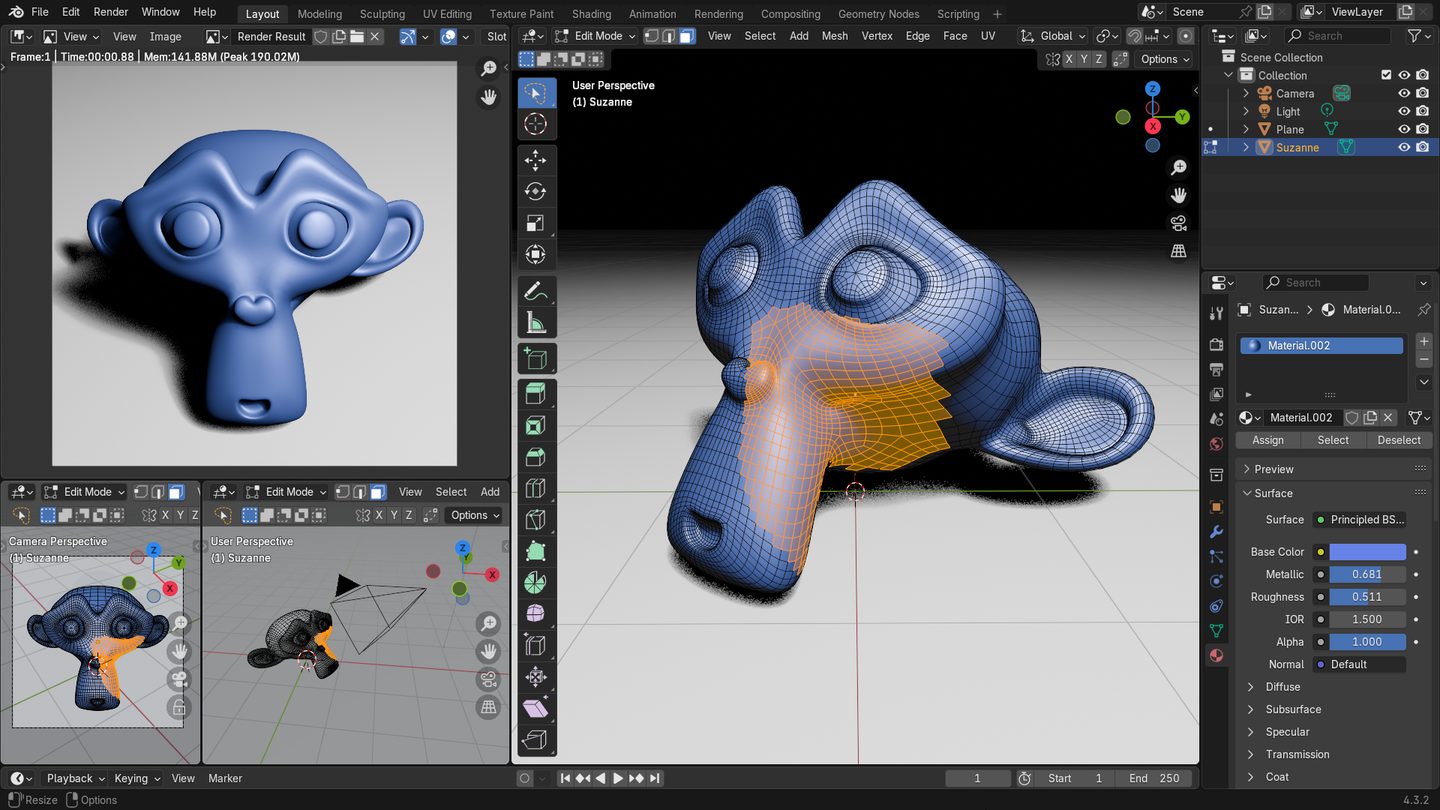
What a week bought
Max hotkeys. The quad menu. The modifier stack. That is the list both BlenderNation and CGPress report, and it is a shrewd choice of three — they are the three things a Max user’s hands actually know. He wrote it by vibe coding, which is to say he described what he wanted to an AI and corrected it until it worked, which is how a single artist gets a week of output out of a week.
He is clear about what it is not. A personal project, not for sale, no download. CGPress describes it as closer to a standalone Max-style layer than a conventional add-on, which sounds right for something that has to intercept the whole event system rather than add a panel.
Two numbers came out of it. His cold start is 14.8 seconds against Max’s 57.0 on the same PC — that is the four-times figure doing the rounds, and it is one machine, measured by the person who built the thing. And the one that made me sit up: he says it opens his real .max files without 3ds Max installed. 23 out of 23 old scenes so far.
The .max claim is the one I would want checked
.max has no public specification. Autodesk has never documented it, the route in has always been the SDK or an export to FBX, and a scene file is not one format anyway — it is a container holding whatever every plugin that touched it decided to write. Open a ten-year-old archviz scene and you are reading V-Ray’s data, and Forest Pack’s, and a modifier from a plugin whose author stopped answering email in 2019.
So “it opens 23 of my 23 scenes” is a sentence with a lot of room in it. It could mean the geometry, transforms and hierarchy come through, which would already be good work and is probably what happened. It could mean something much stronger. Nobody outside his machine has opened the same files, and because the project cannot be downloaded, nobody will. Call it plausible and unverified, by design. The headline number is travelling faster than the caveat, which is how this usually goes.
Why nobody switches, and what this says about that
Blender has been able to look like Max for a long time. People have written Max keymaps for it; BsMax has been on GitHub for years. What is new here is the hour count. One artist, one week, no C++, and the result is apparently close enough to his muscle memory that he prefers it to the real thing.
That lands somewhere specific for anyone who has priced a pipeline. When we worked out where AI earns its place in a 3D pipeline, the answer was the small unglamorous plumbing — the tool nobody budgets a developer for, the script that saves four minutes two hundred times. A UI compatibility layer is the purest version of that. It is pure glue code, deeply boring to write, enormous in effect, and it has never been worth a studio’s TD time because the payoff is one department’s comfort.
It is worth a week now. That is the shift, and it does not need a .max reader to be true.
None of which makes Max a dead tool. Tyson Ibele shipped PhysX vehicles driven from tyFlow’s own flow graph last month, which is serious engineering aimed at people who are clearly still working in Max and intend to keep doing it. The lock-in was always the hands, plus the plugins, plus the farm, plus the client who wants a .max file.
One week got the hands. The hands were only ever the cheap part.