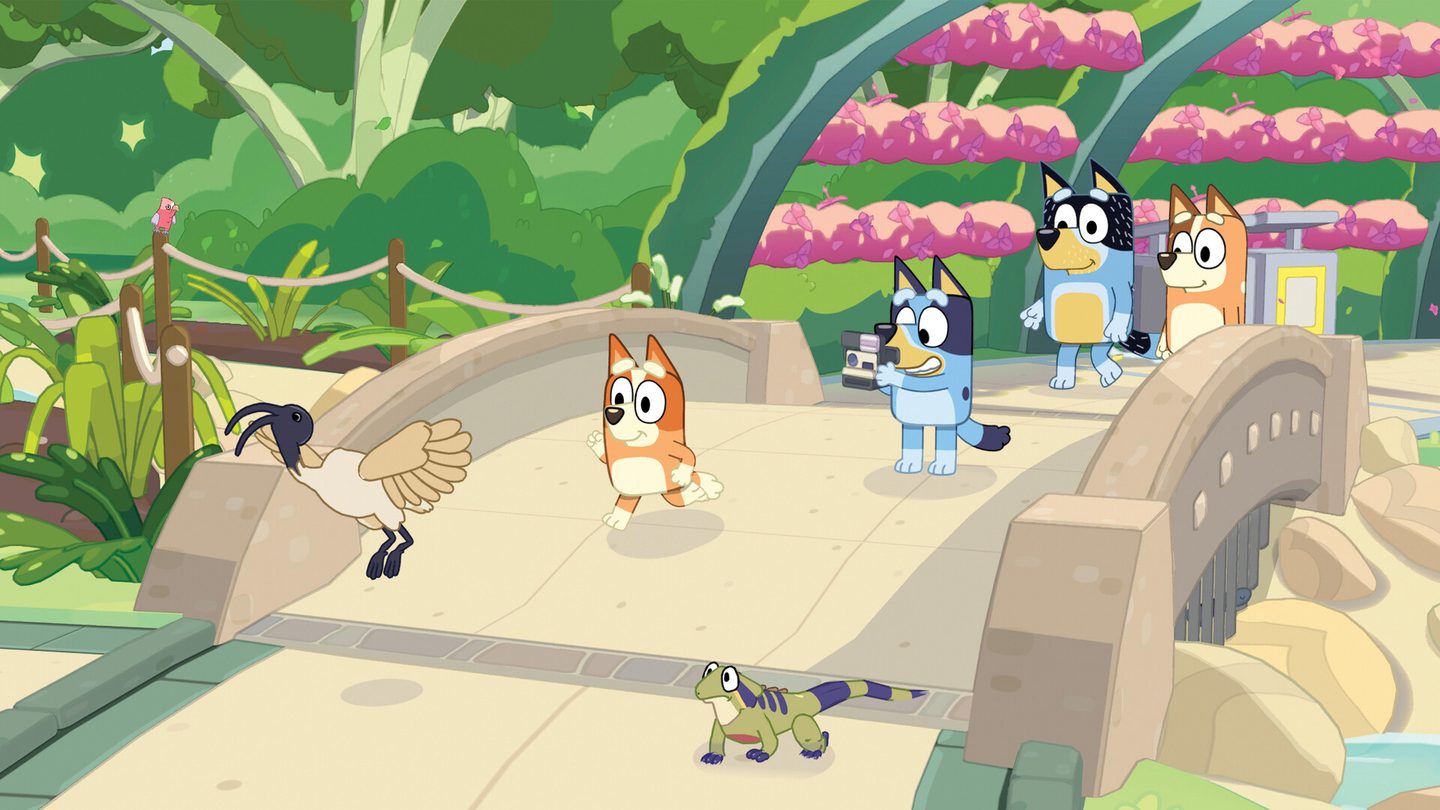
Most of the deeper pipeline detail below comes from a single interview, 80 Level’s, so treat the specifics as reported rather than independently confirmed. The broad shape of it — 2D characters, 3D environments — is corroborated by the studio in a second interview.
The hard part of putting Bluey in a game is not drawing Bluey. It is the head turn.
Ludo Studio’s show is flat. Not stylised-flat, not cel-shaded-flat: the characters are drawings, with the licence a drawing has to be the wrong shape from the wrong angle and still read correctly. Put that character in a 3D world and the problem announces itself the moment anything rotates. Which, in Bluey’s Happy Snaps, is constantly — the game is about taking photographs, so the camera is the controller.
Gameloft Brisbane’s answer, per the breakdown that went round last week, is more literal than I expected.
The characters are planes
They are modelled in Maya as flat, camera-facing planes. No volume, no skull, nothing to rotate. The surface is textured with signed distance fields rather than bitmaps, which is the choice doing most of the visual work: an SDF stores the shape as a distance to an edge instead of a grid of pixels, so the edge stays sharp at any magnification and costs a fraction of the texture memory a bitmap of equivalent crispness would. The eyes are reportedly built from SDF bezier curves — a curve definition rather than an image of a curve.
Then the flat plane gets skinned to a 3D skeleton, rigged in Unreal Engine 5’s Control Rig.
That last sentence is the one worth sitting with. A drawing, bound to bones, posed in world space. It means the animators are doing 3D animation — keys on a rig, in a viewport, in the engine — and what comes out the other end looks hand-drawn. The studio has said Unreal 5.6’s animation work is what made it practical to stop living in Maya.
Seven or eight of everything
A plane facing the camera is fine until the camera walks round it. So there isn’t one rig per character. Game manager Karl von der Lühe told Nintendo Everything the team built multiple versions of each rig based on 45-degree angles; 80 Level’s account puts it at seven to eight camera-facing angles per character. Those agree — a full turn in 45-degree steps is eight — and the odd seven suggests at least one character didn’t need the full set, which is the sort of thing you find out in production rather than plan for.
Eight rigs is eight times the animation, and a children’s game ships with a lot of animation. The team wrote in-house tooling so an animator authors the pose once on a hero angle and it is carried across the rest. That tool is the whole project. Without it the angle count multiplies the content budget by eight and the game doesn’t get made; with it, the cost is a tool programmer and a propagation step that someone has to check.
I’d want to know what happens at the boundaries. Somewhere between two of those angles there is a swap, and a swap in a flat character is a pop unless something hides it. Fast motion hides a lot. A slow, deliberate pan while a child lines up a photograph hides nothing at all.
The outline that doesn’t thin out
The other detail I like: a custom shader that fakes an inverse-hull outline holding constant thickness no matter how far away the character is.
Inverse hull is the old trick — duplicate the mesh, flip the normals, push it out slightly, render it black. It gives you an outline for free, and it has a well-known failure: the line is a world-space offset, so it grows as you approach and thins to nothing as you retreat. In a show, the ink weight is whatever the artist drew. In a game with a camera the player controls, the line has to be measured in screen pixels or the character stops looking drawn at distance.
That is a small fix with an outsized effect, and it is the kind of thing that separates a stylised game from one that just has a filter on it.
The other way round
Compare it to how anime studios solve the same problem. Studio Orange goes at it from the opposite end — real 3D models, warped and redrawn until the faces lie about anatomy the way a drawing is allowed to — and pays for it in asset reuse, because a model you bend per shot is not a model you can reuse across shots. Gameloft starts flat and pays for it in rig count. Both are buying the same thing: permission to break perspective.
The SDF decision also reads differently once you remember where this game has to run. It launched 15 October 2026 across Switch, Switch 2, PlayStation and Xbox consoles and PC, and the original Switch is the machine setting the floor. Texture memory is the first thing to go on that hardware — it is most of what a Switch 2 port costs an art team, never mind a Switch 1 one. Characters whose entire appearance is a handful of distance fields and a shader are very cheap to keep resident. Eight rigs are not free either, but rigs are CPU and memory for skeletons, not VRAM for maps.
What reviewers have flagged lands about where you’d predict. One noted characters gazing forward instead of at whoever they’re talking to in cutscenes. A cast that only exists at eight discrete facings will struggle with an eyeline, and cutscenes are precisely where an audience looks for one.