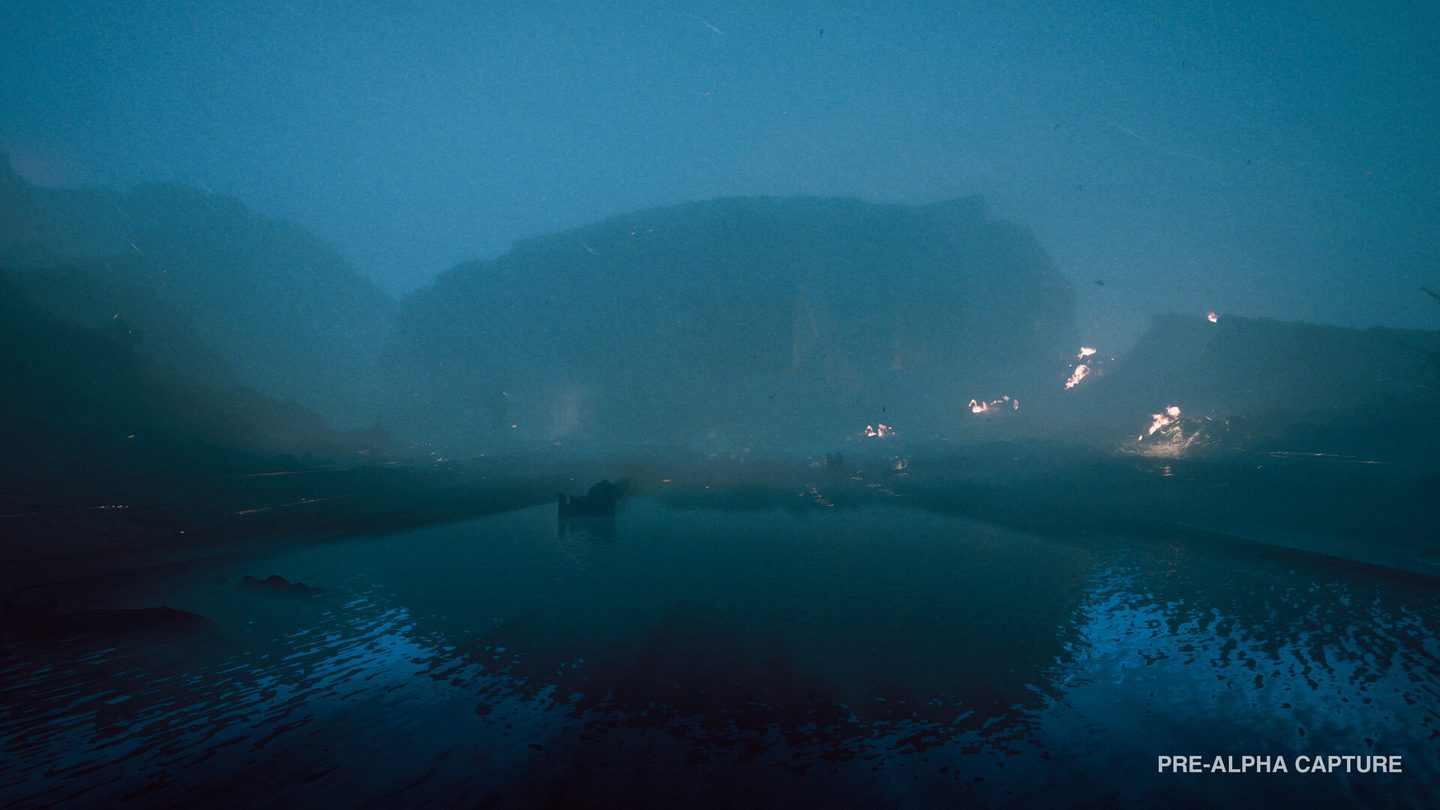
Creative Assembly is rebuilding the Alien look in somebody else’s engine. The 2014 game ran on Cathode, the studio’s own renderer, and job listings spotted in April 2026 describe the sequel as being built in Unreal Engine 5. That has been treated as settled ever since, and nobody at Sega has corrected it.
For anyone who dresses environments for a living, that is the interesting line in the whole announcement. Cathode was built for one job: a handful of interlocking metal rooms, lit almost entirely by lamps you can see in frame, with smoke in the air and a very long shadow behind every pipe. It was narrow and it was good at being narrow.
The archive is the real asset
When Fox opened its vaults for the first game, Creative Assembly got roughly three terabytes of original production material — behind-the-scenes photographs, video, design blueprints, costume shots, a lot of it never published. The team built a ’70s sci-fi style guide out of it and kit-bashed from there.
Art director Ana Sopikova has said the team still has that archive, and uses it to look at how things were actually built.
That sentence is worth sitting with, because a photograph of a built set is a different class of reference from a painting of one. Concept art tells you what somebody wanted. A production still tells you that the console bezel was vacuum-formed plastic with a visible seam, that the “metal” wall was painted board, that the grime sits in the corners where a hand never reached. You get material behaviour for free, and material behaviour is most of what sells a surface. The same problem turns up in television: Widow’s Bay won its set decoration award for looking undesigned, which is the hardest thing to fake from a mood board.
Low-fidelity references also age well. The Nostromo was deliberately cheap — CRT phosphor, segmented LED, chunky toggle switches, no curved glass anywhere. Reproduce that honestly and it still reads in 2026, where a 2014 attempt at “futuristic” mostly does not.
Outdoors is a lighting problem
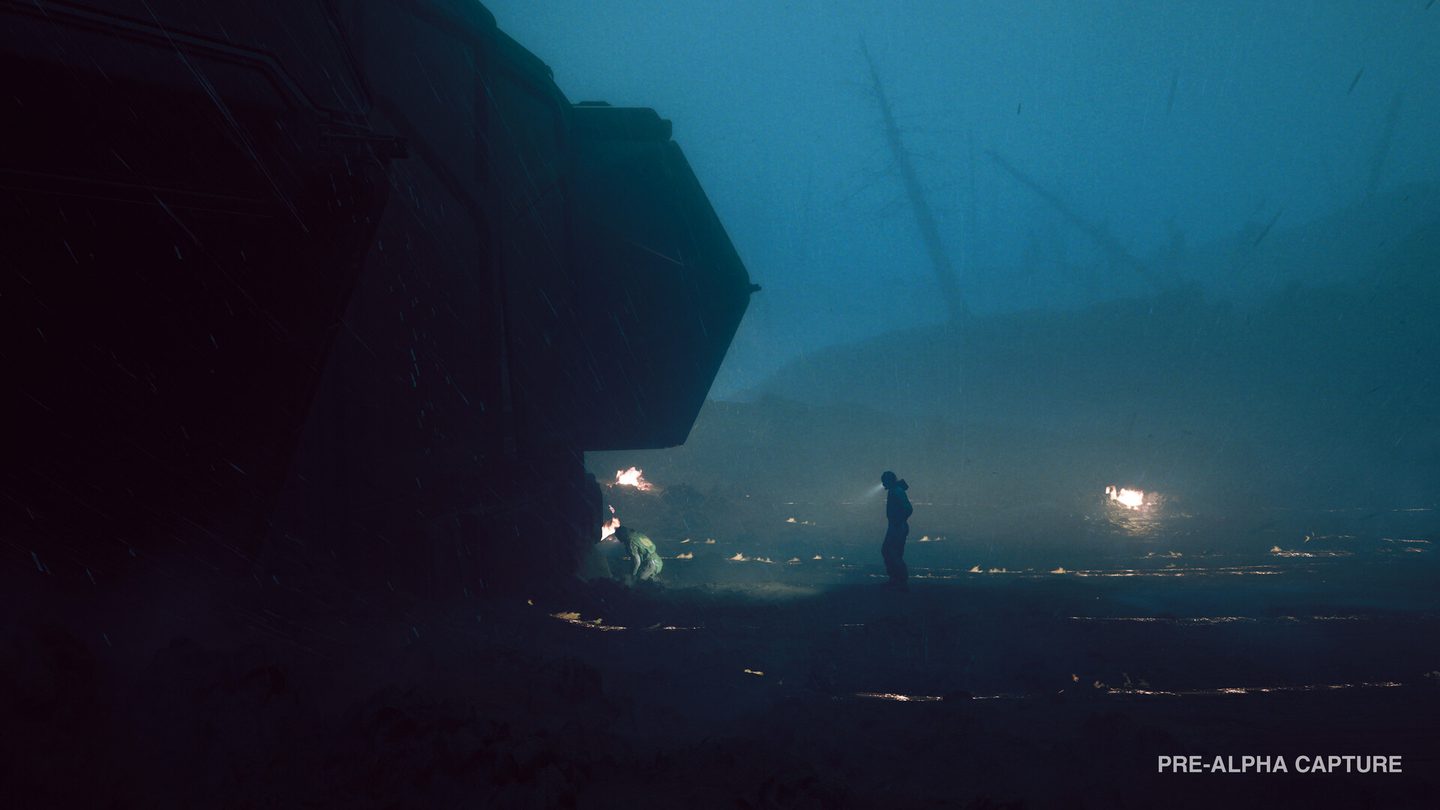
The teaser Sega put out on Alien Day, 26 April 2026, called False Sense of Security, is mostly darkness: a door unlocking onto rain, then an emergency phone booth. It runs about half a minute — accounts of its exact length differ — and there is no Xenomorph in it. On 8 June, Sega’s own release announced the game properly for PS5, Xbox Series X|S, Switch 2 and PC, with a trailer titled Last Chance. The Summer Game Fest footage took the horror onto a colony planet surface.
Which quietly removes the thing the first game was built around.
A corridor is a gift. It bounds the view, so you can afford detail. It gives you a reason for every light, because somebody bolted that lamp to that wall. It controls what the player can hear and from where. It also does your occlusion for you. Outdoors on a planet, you are art-directing a sky, and a sky has no motivated source you can switch off for a scare.
Rain and night are the obvious answer, and the teaser suggests Creative Assembly reached for both. Wet surfaces give you speculars to light with and reflections that read as information. Darkness keeps the contrast ratio the original lived on. But a wet night exterior is a far more expensive frame than a dim corridor, and it is where open-world horror usually goes soft: the fog that hides your draw distance also flattens the shadows that were doing the frightening.
What the engine will push back on
Lumen and Nanite are superb at things the Nostromo is not. Lumen’s bounced light wants to fill a room pleasantly. Nanite rewards geometric density, which is why so many UE5 games arrive looking like a photoscan. The 1979 aesthetic runs the other way — hard-edged, sparse, chunky, lit by one or two sources with nothing filling the shadow side.
None of that is beyond the engine. It is a question of how much of the default you are prepared to switch off, and whether your material library is built on measured response instead of megascans. CD Projekt went through the same migration and the cost showed up as headcount, not as a render setting — the Witcher 4’s 2028 target has a number 500 underneath it. Leaving your own renderer buys you hiring, tooling and a decade of other people’s bug fixes. It costs you every trick your own engine learned about your own game.
Creative Assembly has one advantage CD Projekt did not: the look it is protecting was documented on film by somebody else, fifty years ago, and that documentation is sitting on its server.
Confirmed as of today: PS5, Xbox Series X|S, Switch 2 and PC; Unreal Engine 5; a colony setting; no release date and no price, with Sega and Creative Assembly saying at gamescom 2026 that none was coming there either.