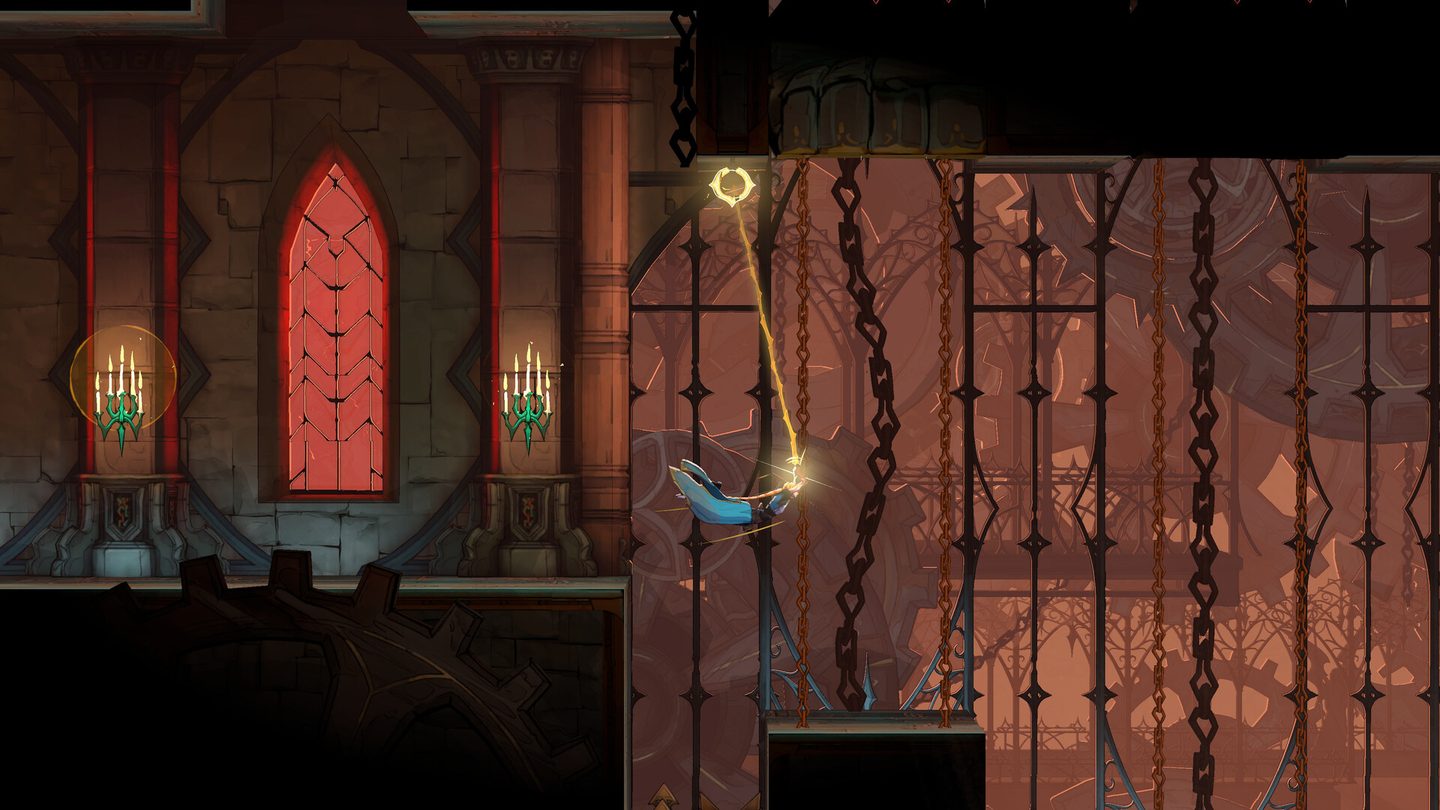
Reviews for Castlevania: Belmont’s Curse went up on 13 October, two days before the game’s 15 October release — some storefront listings show the 14th, while Konami’s own materials and the game’s Steam news post say the 15th. Konami did not hold reviews to launch day, which for a dormant franchise handed to an outside studio is a confident decision.
Across the twelve scored verdicts I could verify and convert, the average is 8.5. The range runs from 6 to 10 — four points wide on a ten-point scale. OpenCritic has it at 85 from fifty critics with 98 percent recommending; Metacritic sat at 86 from forty-four at the time of writing. TheGamer worked out that an 86 makes this the fifth highest-rated traditional Castlevania ever, behind Circle of the Moon and Aria of Sorrow at 91, and Symphony of the Night and Dawn of Sorrow at 89.
Four points is a lot of disagreement for a game nobody dislikes.
Everyone agrees about the pictures
Read the twelve and the praise is interchangeable. The colour. The whip. The music. GamesRadar+ calls it gothic brilliance. Polygon talks about bold colour making the gothic visuals pop. Even VGC, at the bottom of the range, led its headline with the game looking incredible.
Then the complaints, which are all about shape. Rock Paper Shotgun’s verdict is “a fantastic action game, a less than stellar Metroidvania”. IGN’s argument is that it works better as a Metroidvania generally than as a Castlevania specifically. Push Square, at 7, calls it perfectly fine and says longtime genre players will find little new. RPGSite describes a frustrating start and a late game that goes extremely easy. TheSixthAxis, at 8, picks on fast travel.
The arguments are all about the map and the pacing laid over it.
Which is the one thing Evil Empire had never built
Evil Empire is the studio that spent years maintaining and expanding Dead Cells, and Motion Twin advised on this. That lineage is not a footnote. It describes a specific production pipeline, and the pipeline predicts which half of this review spread you get.
A roguelike’s levels are assembled at run time. The artists and designers build a library of rooms and transitions that have to work in any order, because the game will put them in any order. Every room gets judged on whether it reads instantly, whether its silhouette is clear at speed, whether the player can tell where the floor is in the first sixth of a second. That discipline makes you extremely good at local craft: readability, animation weight, colour separation, the frame-by-frame feel of a hit landing.
What it never asks you to do is author one map.
A Metroidvania map is a single object. It is one artefact where position carries meaning — this door matters because of what is three rooms behind it, this shortcut matters because of how long you spent walking the long way, this boss gates that ability because the ability reframes a corridor you already hate. You cannot iterate on that in pieces. You build the whole thing, walk it end to end, find that the middle sags, and rebuild the whole thing. It is slow, it is unglamorous, and getting it right is the entire difference between a Metroidvania people replay for fifteen years and one they finish once.
So a studio with Dead Cells behind it and a Castlevania in front of it starts with a surplus of exactly the skills that make rooms sing, and a deficit of the one skill that makes a map sing. The reviews describe that distribution precisely. Nobody questions the rooms. The people at 6 and 7 are describing fast travel, backtracking and a difficulty curve — all of them properties of the whole map rather than any part of it.
I should be careful here, because this is a reading from the outside. I have not walked the castle. What I can say is that when twelve reviewers agree about every local quality and split four points on structure, the production history behind the split is usually visible, and in this case it is.
The colour decision is a real one
One thing worth sitting with, because it is the part reviewers noticed first without quite saying why.
Castlevania’s 2D canon was built under hardware limits. Symphony of the Night and the GBA and DS games ran on fixed palettes and tight sprite budgets, and a lot of what people remember as masterful art direction was restraint that the hardware enforced. Modern 2D has no such limit. You can put every colour on screen, and the genre’s instinct when you can is to desaturate everything into brown and grey, because murk reads as gothic and murk hides inconsistency between artists.
Choosing saturation in a vampire castle is a readability decision disguised as a style decision. Bright colour means every silhouette has to hold up on its own, because nothing is hiding in the dark. Reviewers describing the visuals as popping are describing a team that backed itself.
Three in a row, the same shape
This is now the third review on this blog in three weeks where critics agree on the surface and split on the systems. Silent Hill: Townfall averaged 8.0 across a four-point spread, with reviewers calling the atmosphere franchise-best and then arguing about the stealth — also a dormant Konami property, also handed to an outside studio. A fortnight later, Hellraiser Revival’s six verdicts ran from 4.5 to 8.5 while every one of them liked how the Labyrinth looked.
I do not think that is a coincidence of the calendar. Look and feel are now reliably achievable: the tools are mature, reference is abundant, and a good art team with a clear brief lands them. Structure is not, because structure is one person’s judgement about an artefact too large to hold in your head, and no tool helps. The craft floor has risen and the design ceiling has not moved, so the variance in reviews migrated to where the hard problem still lives.
The number
8.5, from twelve converted verdicts between 6 and 10. Famitsu’s four reviewers filed 8/8/8/8 for 32 out of 40, which is as close to a consensus vote as that panel ever gives. The mean tracks both aggregators, so the figure is not an artefact of which twelve I happened to find.
The four-point range matters more to a buyer than the mean does. Somebody who wants a beautiful 2D action game with a whip is being told by everybody that this is one. A buyer who wants the map that made Symphony of the Night worth twenty-nine years of imitation is reading twelve reviews that do not agree, and should read the ones at the bottom before the ones at the top.